

News — Treasures of NAASR's Mardigian Library
Treasures of NAASR's Mardigian Library ~ Maps and Atlases

 For this installment of the Treasures of NAASR's Mardigian Library, we have chosen examples and maps and atlases and a few related works from our holdings. They are not necessarily selected for their beauty (although some are indeed beautiful) nor for their age (though some are quite old) but because they tell an interesting story and reflect the diversity of approaches to mapping Armenia over the past 325 years, which is the time period reflected in the maps included in this feature.
Treasures of NAASR's Mardigian Library ~ "Having a Grand Time:" Armenian Summer Resorts in the Catskills, Revisited

 Wherever you are reading this, it is probably hot—perhaps very hot—so we thought a getaway to a cool, shady place with the chance of a swim might provide some relief, and it is in that spirit that we offer a Treasures of NAASR's Mardigian Library mini-feature on Armenian summer resorts in the Catskills of days gone by.
Treasures of NAASR's Mardigian Library ~ The Avedis Derounian (John Roy Carlson) Archive: A Selection

 In the late 1930s and 1940s Armenian-American author and journalist Avedis Derounian (1909-91) went underground and infiltrated and collected materials on the full spectrum of U.S.-based extremist groups.
Annual Appeal 2021 ~ Tis the Season of Giving

 In these perilous times for Armenia, drawing attention to Armenia’s cultural and historic contributions to world heritage is crucial. Your donation will strengthen NAASR’s ability to increase worldwide awareness through live, online programming on Armenia and Artsakh of the history of the region as well as current threats and endangered cultural treasures and monuments.
From Venice to Boston: The Awgerean Brothers, Hamilton Fish, and Vartan Gregorian ~ Treasures of NAASR's Mardigian Library

 We offer this in tribute to all of those who keep the spirit of learning and the love of books alive, from the Mekhitarist Fathers of San Lazzaro to Vartan Gregorian.
E. A. Yeran: Pioneering Armenian-American Printer and Publisher, Part 2 ~Treasures of NAASR's Mardigian Library

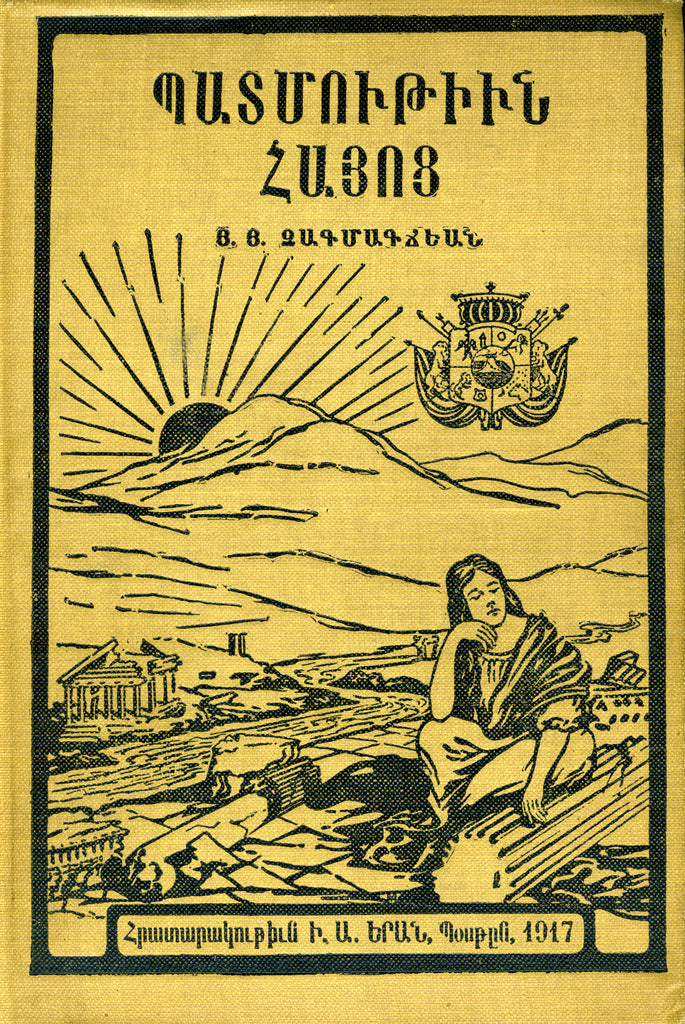 Part 1 of our Library Treasures feature on the work of Edward Arakel Yeran presented books published by his Yeran press through ca. 1915. Part 2 continues and brings to a conclusion this work.
A Banquet for the Ages: The Civil and Military Missions of Armenia to the U.S. in Boston, 1919

 To mark May 28, the anniversary of the declaration of the first independent Republic of Armenia in 1918, we focus on one object from NAASR’s Mardigian Library.
Genocide Survivor Memoirs in Armenian & English, 1918-1955 ~Treasures of NAASR's Mardigian Library

 In this feature we highlight a group, by no means exhaustive, of memoirs by survivors of the Armenian Genocide published in Armenian and English between the years 1918 and 1955. In these memoirs we hear the voices of women and men, clergymen and political activists, natives of the eastern provinces of the Ottoman Empire and of western Asia Minor, Protestant and Apostolic, intellectuals and “average” women and men, as well as one non-Armenian, an Assyrian whose people suffered largely the same fate as the Armenians.
Treasures of NAASR's Mardigian Library ~ Khrimian Hayrik (1820-1907)

 He is a figure which steps straight out from the Old Testament with all the fire and all the poetry. H. F. B. Lynch (Travels and Studies in Armenia)
In 1820 two prominent Armenians were born who devoted their lives to Armenia and the Armenian people and were venerated by their contemporaries. Khrimian Hayrik (1820-1907) was an Armenian Apostolic Church leader, educator, and publisher who became the Patriarch of Constantinople and later Catholicos of All Armenians. Ghevond Alishan (1820-1901) was a philologist, historian, geographer, translator, a member of the Mkhitarist Congregation in Venice.