Dr. Owen Miller, the author of a thesis and several research articles on the Sasun massacre of 1894 and its background, will discuss with Dr. Jelle Verheij his findings and the need for revision of the traditional perspectives, touching on many of the key issues and players: the death toll, characteristics and motivation of the perpetrators, the roles of the Ottoman authorities, foreign powers and Armenian revolutionary parties.
The Horrors of Adana offers one of the first close examinations of these events, analyzing sociopolitical and economic transformations that culminated in a cataclysm of violence. Drawing on primary sources in a dozen languages, he develops an interdisciplinary approach to understand the rumors and emotions, public spheres and humanitarian interventions that together informed this complex event.
Professor Ron Suny, emeritus of the University of Chicago and the University of Michigan -- and author of a major study of the massacres and deportations committed by the Ottoman Turks in 1915, "They Can Live in the Desert But Nowhere Else": A History of the Armenian Genocide (Princeton University Press, 2015) -- uses the insights of Moses' work to take a fresh look at the Armenian tragedy and how it provides another lens to look at the concept of genocide.
Gathering an international group of scholars, Armeno-Indica explores the Indo-Armenian saga in South Asia from the seventeenth to the twenty-first centuries. Themes to be explored include the connected economic, literary, legal, and political histories of Armenians and Indians in South Asia and beyond across the waters of the Indian Ocean. The keynote for the conference will be delivered by Professor Sanjay Subrahmanyam.
Ohannes Kurkdjian is regarded as one of the prominent Armenian photographers of the late 19th and early 20th centuries. He is best known as the first photographer to capture images of the medieval ruins located in the ancient Armenian capital of Ani.
Dr. Owen Miller, the author of a thesis and several research articles on the Sasun massacre of 1894 and its background, will discuss with Jelle Verheij his findings and the need for revision of the traditional perspectives, touching on many of the key issues and players: the death toll, characteristics and motivation of the perpetrators, the roles of the Ottoman authorities, foreign powers and Armenian revolutionary parties.
Dr. Artyom Tonoyan's talk will focus on some of the most interesting and critical themes emerging from the decades-long Soviet and Russian press coverage of the Nagorno-Karabakh conflict.
The Armenian contribution to Ottoman photography is supposedly well known, with histories documenting the famous studios of the imperial capital, Ottoman Armenian-run establishments that produced Orientalist visions for tourists and images of modernity for a domestic elite.
The presentation will focus on the problem of how the memory of trauma, survivors of genocide and repression interact. In some cases, they can develop in parallel, independently of each other. In others, the memory of repressions is formed according to the model of memory of the genocide, when the memory of repressions repeats some of the mechanisms developed in connection with the memory of the genocide, both at the individual and institutional levels (compare with the multidirectional memory according to M. Rothberg). And thirdly, the memory of repression can be contrasted with the memory of genocide.
Launching a new exhibit from the Armenian Image Archive, the panelists will explore the fourteen "Stations of the Cross" along the Via Dolorosa in Jerusalem, highlighting photographs from the Bonfils Studio in 1875 and new images from photographer Jack Persekian,



 Dr. Owen Miller, the author of a thesis and several research articles on the Sasun massacre of 1894 and its background, will discuss with Dr. Jelle Verheij his findings and the need for revision of the traditional perspectives, touching on many of the key issues and players: the death toll, characteristics and motivation of the perpetrators, the roles of the Ottoman authorities, foreign powers and Armenian revolutionary parties.

 The Horrors of Adana offers one of the first close examinations of these events, analyzing sociopolitical and economic transformations that culminated in a cataclysm of violence. Drawing on primary sources in a dozen languages, he develops an interdisciplinary approach to understand the rumors and emotions, public spheres and humanitarian interventions that together informed this complex event.

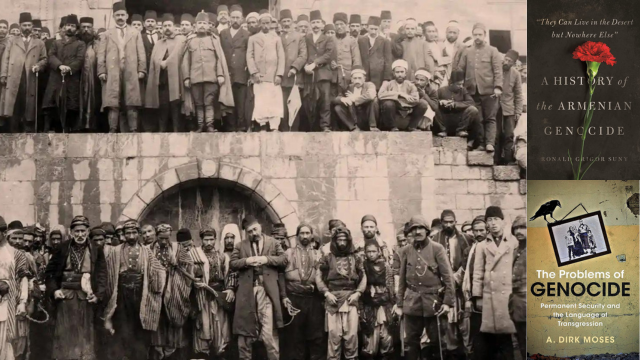 Professor Ron Suny, emeritus of the University of Chicago and the University of Michigan -- and author of a major study of the massacres and deportations committed by the Ottoman Turks in 1915, "They Can Live in the Desert But Nowhere Else": A History of the Armenian Genocide (Princeton University Press, 2015) -- uses the insights of Moses' work to take a fresh look at the Armenian tragedy and how it provides another lens to look at the concept of genocide.

 Gathering an international group of scholars, Armeno-Indica explores the Indo-Armenian saga in South Asia from the seventeenth to the twenty-first centuries. Themes to be explored include the connected economic, literary, legal, and political histories of Armenians and Indians in South Asia and beyond across the waters of the Indian Ocean. The keynote for the conference will be delivered by Professor Sanjay Subrahmanyam.

 Ohannes Kurkdjian is regarded as one of the prominent Armenian photographers of the late 19th and early 20th centuries. He is best known as the first photographer to capture images of the medieval ruins located in the ancient Armenian capital of Ani.

 Dr. Owen Miller, the author of a thesis and several research articles on the Sasun massacre of 1894 and its background, will discuss with Jelle Verheij his findings and the need for revision of the traditional perspectives, touching on many of the key issues and players: the death toll, characteristics and motivation of the perpetrators, the roles of the Ottoman authorities, foreign powers and Armenian revolutionary parties.

 Dr. Artyom Tonoyan's talk will focus on some of the most interesting and critical themes emerging from the decades-long Soviet and Russian press coverage of the Nagorno-Karabakh conflict.

 The Armenian contribution to Ottoman photography is supposedly well known, with histories documenting the famous studios of the imperial capital, Ottoman Armenian-run establishments that produced Orientalist visions for tourists and images of modernity for a domestic elite.

 The presentation will focus on the problem of how the memory of trauma, survivors of genocide and repression interact. In some cases, they can develop in parallel, independently of each other. In others, the memory of repressions is formed according to the model of memory of the genocide, when the memory of repressions repeats some of the mechanisms developed in connection with the memory of the genocide, both at the individual and institutional levels (compare with the multidirectional memory according to M. Rothberg). And thirdly, the memory of repression can be contrasted with the memory of genocide.

 Launching a new exhibit from the Armenian Image Archive, the panelists will explore the fourteen "Stations of the Cross" along the Via Dolorosa in Jerusalem, highlighting photographs from the Bonfils Studio in 1875 and new images from photographer Jack Persekian,