

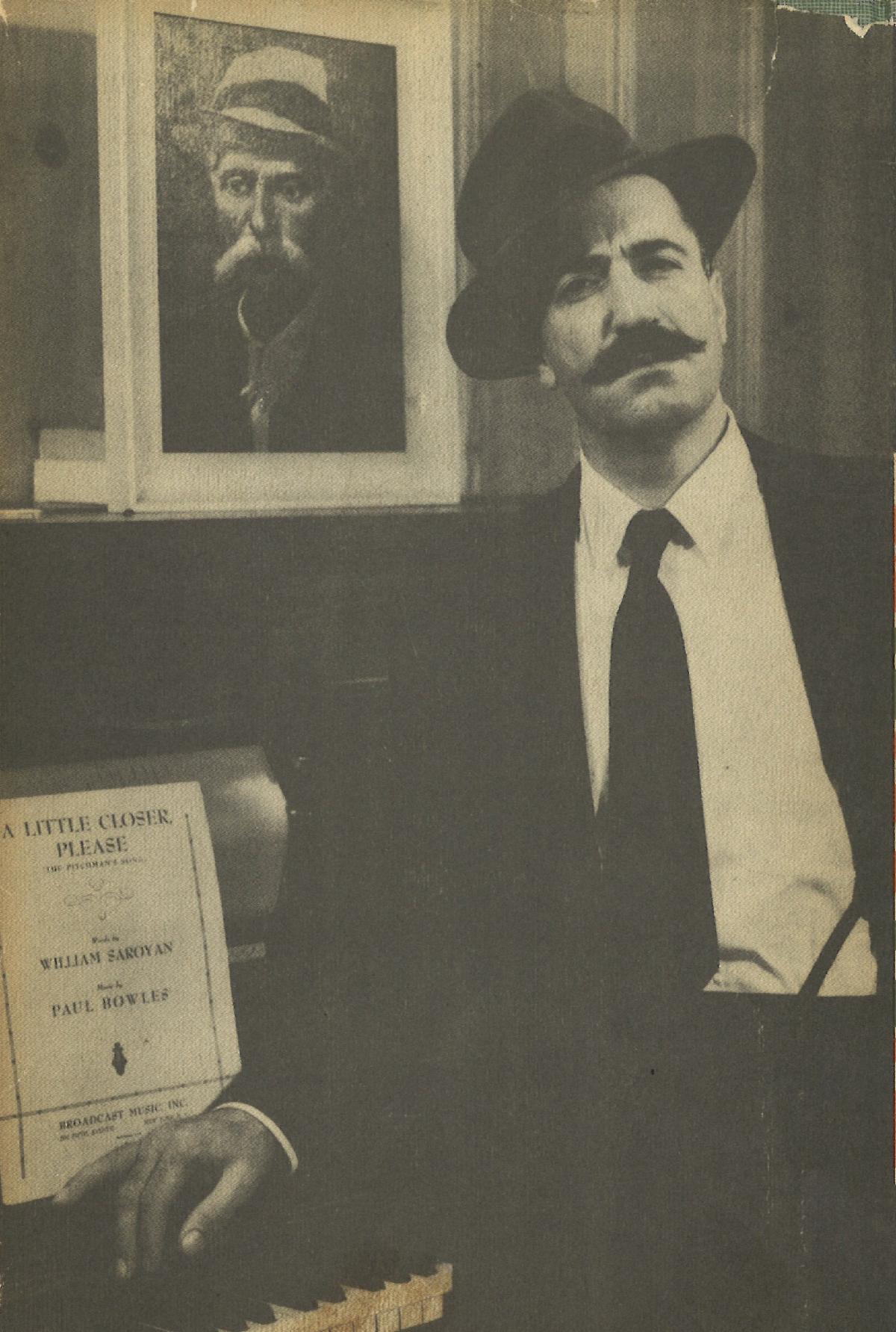
William Saroyan (1908–81) was the most famous Armenian-American writer of his time and, arguably (and with all due respect to the many fine writers who have followed) may remain so to this day. Extraordinarily prolific and possessed of a larger-than-life personality, the Fresno-born author also had an on-again, off-again relationship with NAASR dating back to its early days.
By the time NAASR was established in 1955, Saroyan had been a prominent figure in American literature for two decades, since he exploded on the scene in 1934 with the publication of his first book, The Daring Young Man on the Flying Trapeze. By the mid-1950s, he had had his ups and downs and ups again, with his most recent work including the short story collection The Assyrian and Other Stories (1951), the memoir The Bicycle Rider in Beverly Hills (1952), the novel The Laughing Matter (1953), and the short play The Stolen Secret (1954).
In September 1955, NAASR, which had been publicly launched earlier in the year in March, was preparing to officially begin its fundraising campaign to establish the first chair in Armenian Studies in the United States, at Harvard University, with a banquet at the Harvard Club in Boston. Among the speakers announced were Harvard President Nathan Pusey, Massachusetts Lt. Governor Sumner G. Whittier, and William Saroyan, although it appears that Saroyan's presence was far from a certainty.
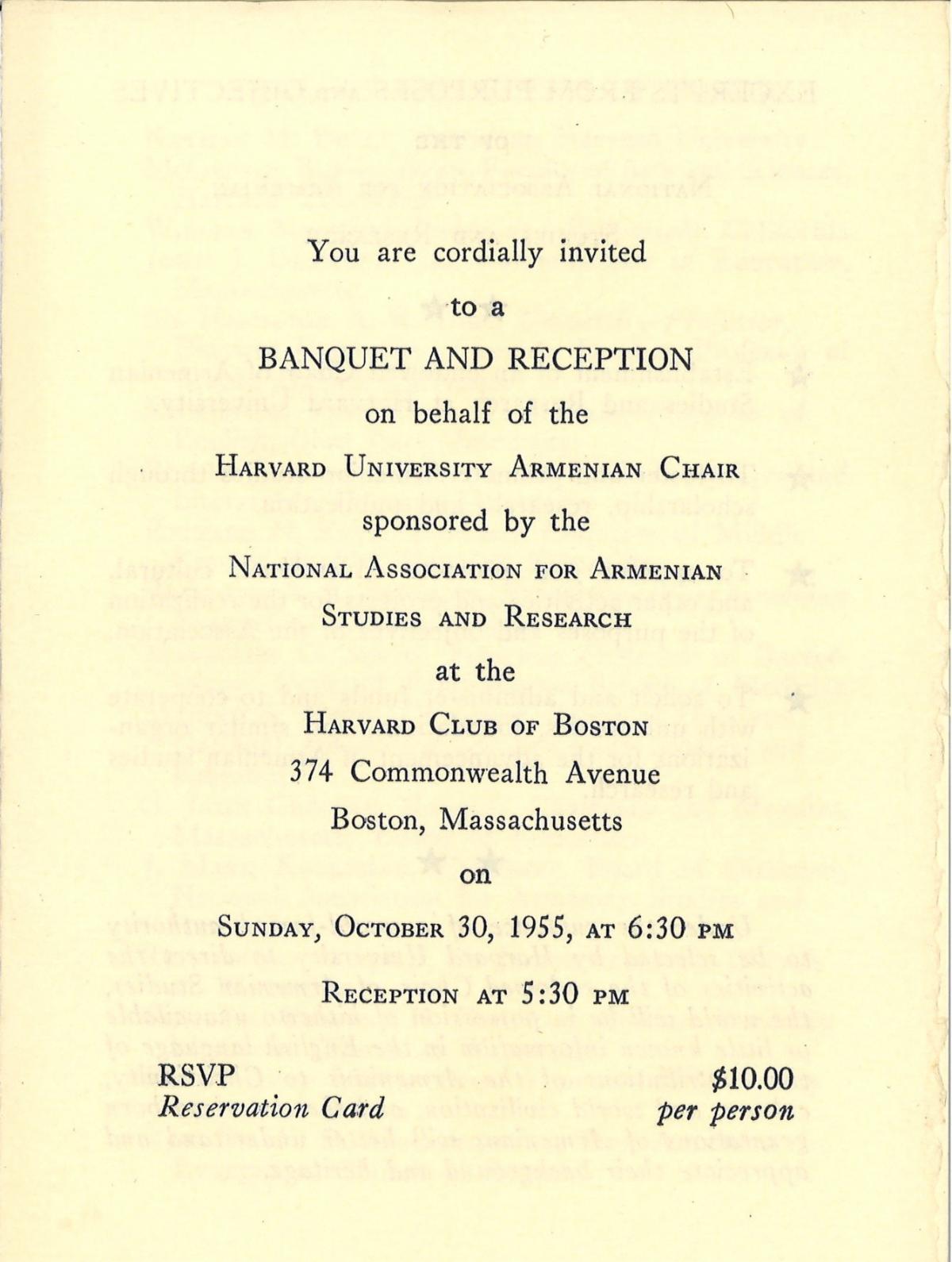
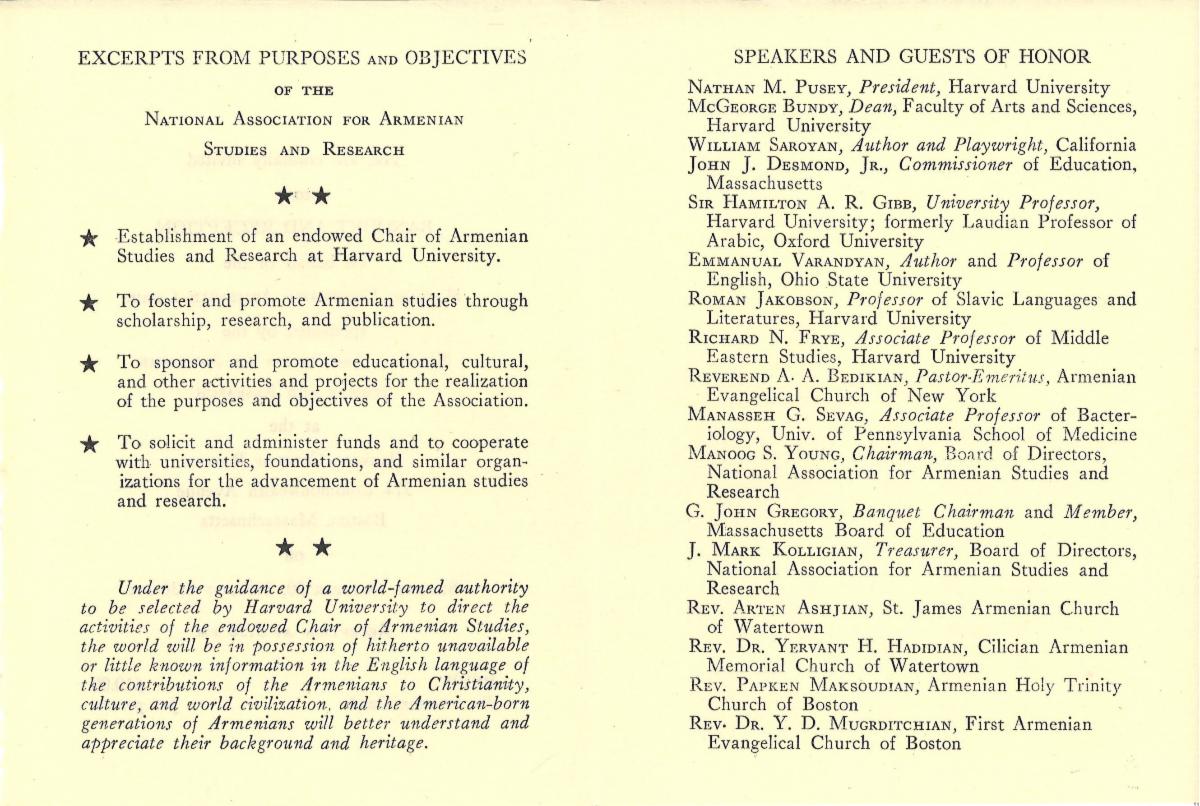
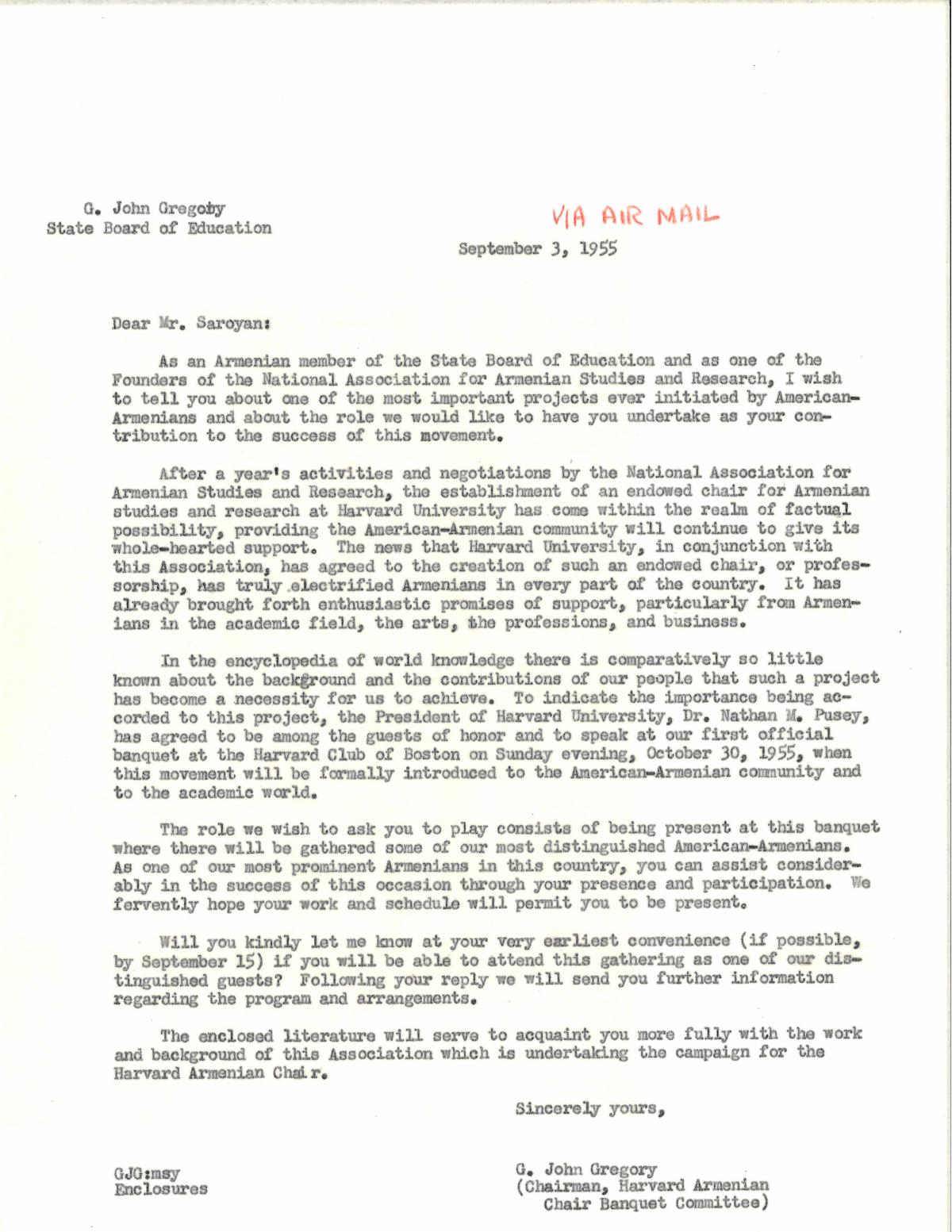
On September 3, NAASR board member G. John Gregory, a member of the Massachusetts State Board of Education and the chair of the Harvard Armenian Chair Banquet Committee, wrote to Saroyan informing the author about the new organization and its major undertaking, writing that "[t]he news that Harvard University, in conjunction with this Association, has agreed to the creation of such an endowed chair, or professorship, has truly electrified Armenians in every part of the country." Gregory then invited Saroyan to be present on October 30 "when this movement will be formally introduced to the Armenian-American community and to the academic world."
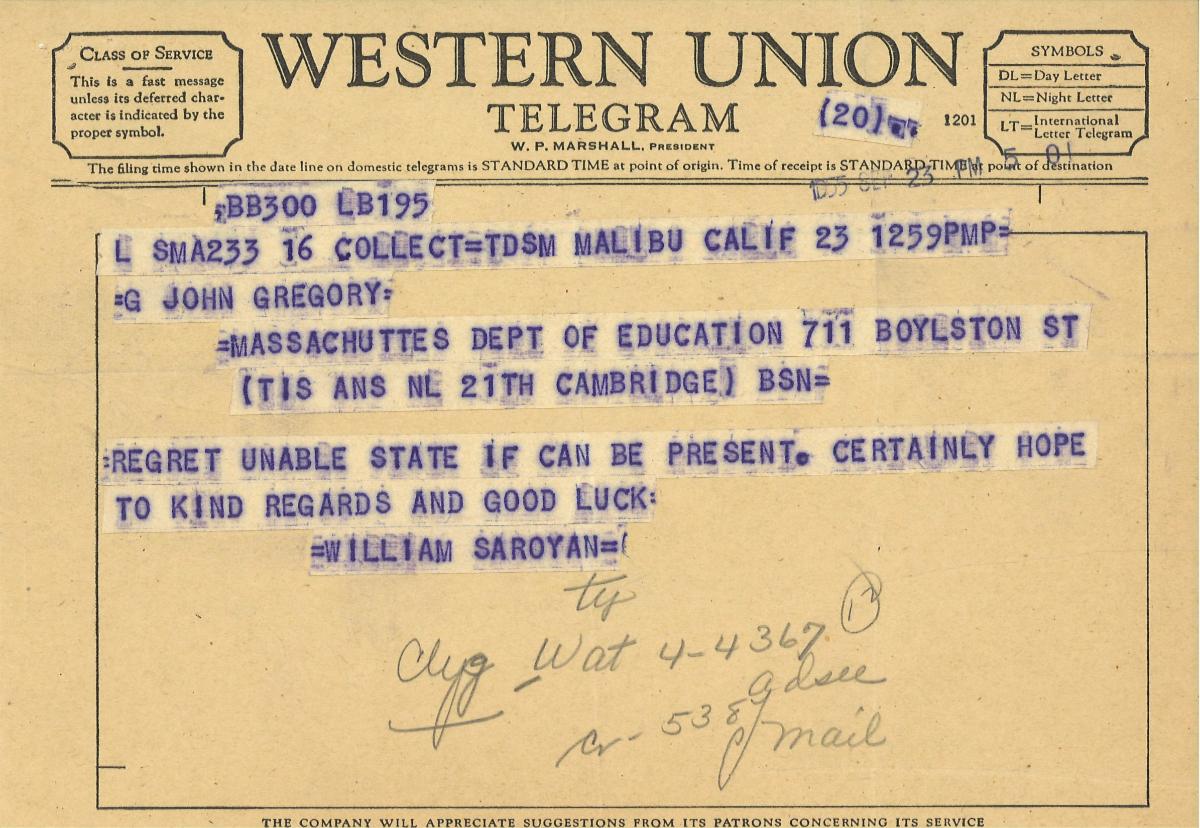
Saroyan replied by telegram from Malibu, CA, on September 23, "REGRET UNABLE STATE IF CAN BE PRESENT. CERTAINLY HOPE TO KIND REGARDS AND GOOD LUCK." Gregory replied on September 27 that "we are taking the liberty of including your name in our publicity among those of our guests and speakers."
Sometime in October, NAASR's Board Chairman Manoog S. Young met with Saroyan, presumably in New York City. Young wrote to Saroyan on October 26 that "when I returned and told the others of your interest, they were more than elated and are anxiously looking forward to seeing you," so it appears that he had secured the author's participation.
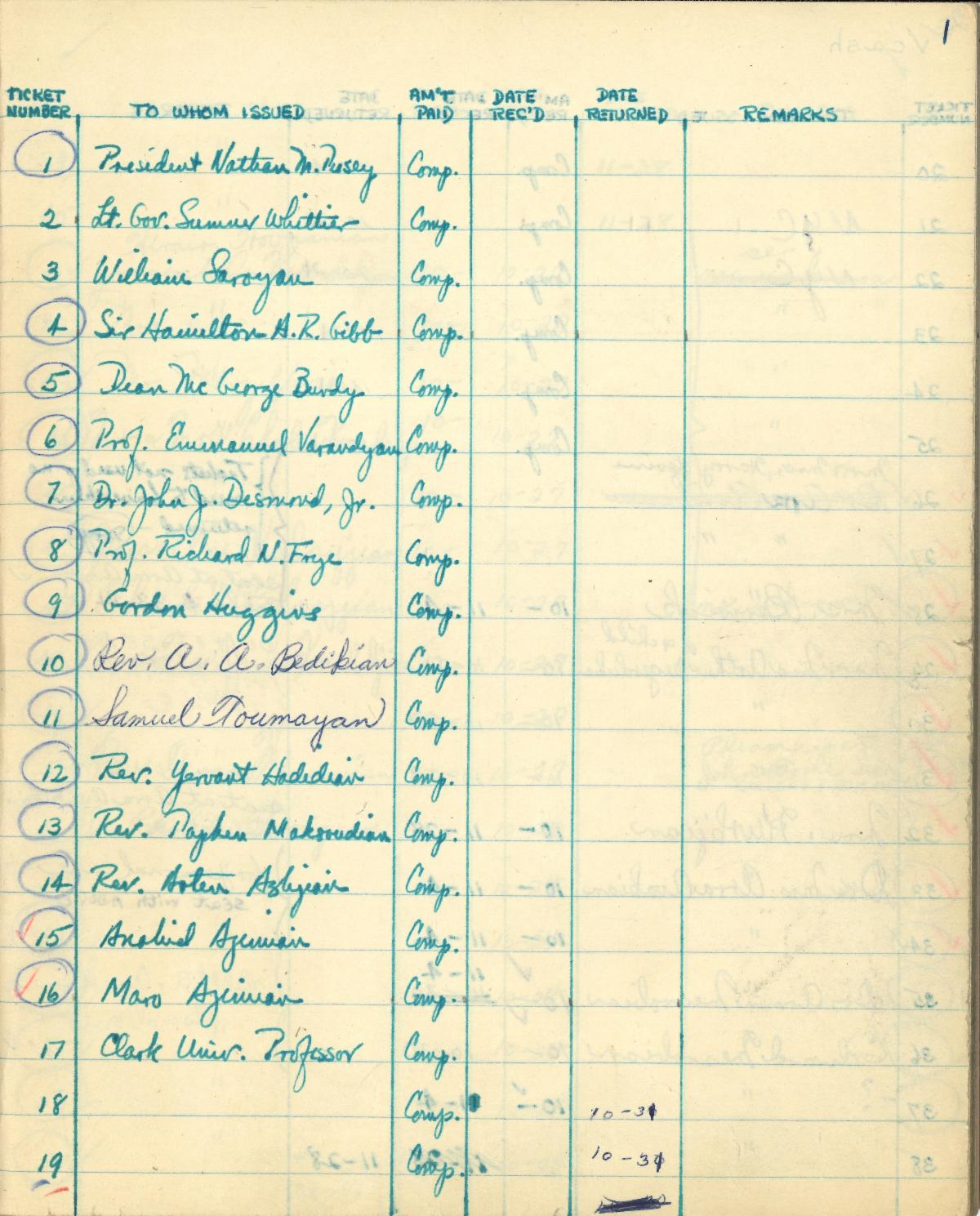
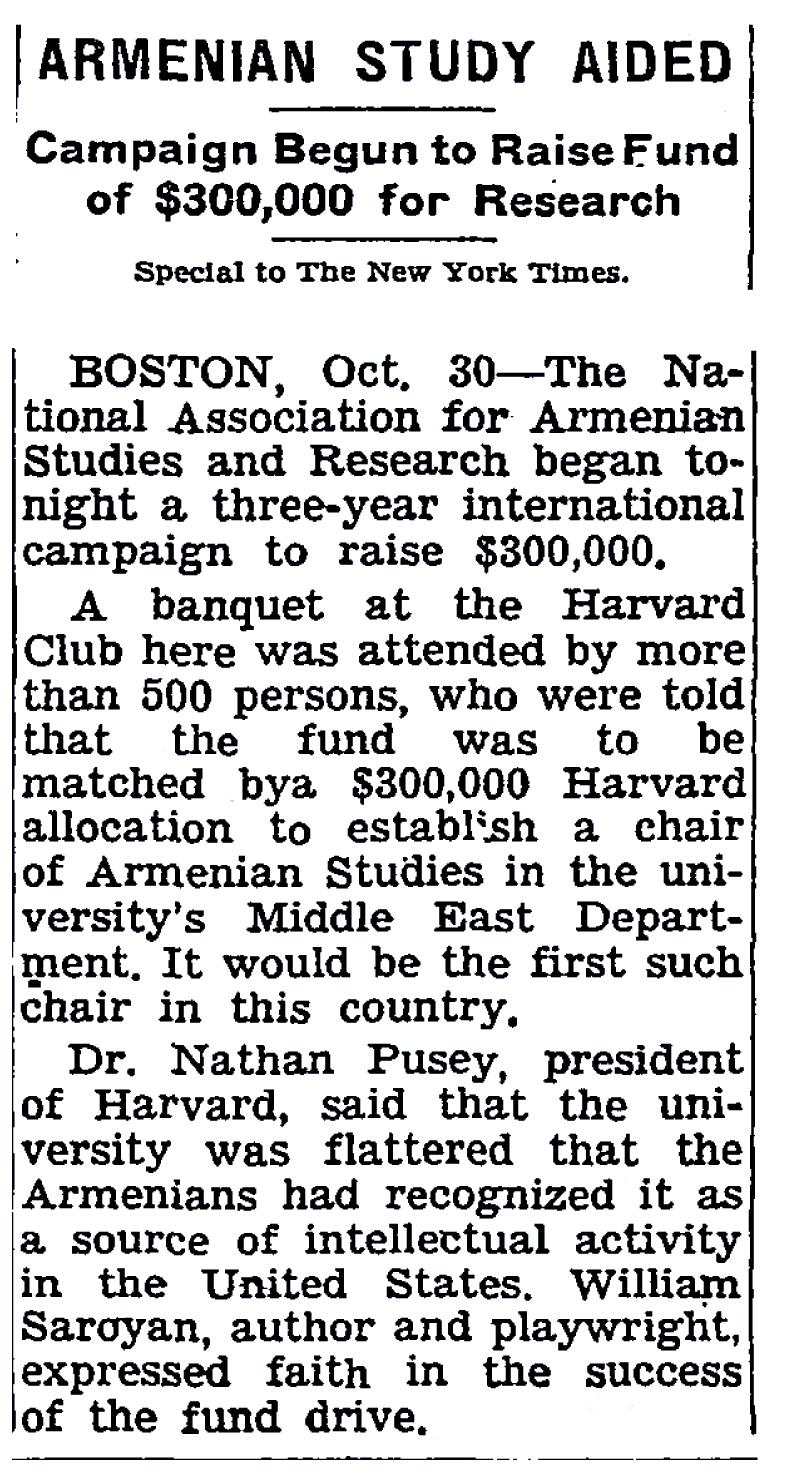
Not only was Saroyan present on October 30 but he also spoke, no doubt contributing the positive energy of the banquet, attended by more than 500 people, and which saw Chairman Young present pledges totaling $30,000 to Harvard Dean of the Faculty of Arts and Sciences (and future U.S. National Security Advisor) McGeorge Bundy. Owing to the fundraising success, it was announced in early November that in 1956 it would be possible for "a limited program for the advancement of Armenian studies and research at [Harvard's] Center for Middle Eastern Studies." By 1957, sufficient funds had been raised to allow the hiring of Avedis K. Sanjian as research fellow in Armenian Studies; and by May 1959, the $300,000 total had been reached.
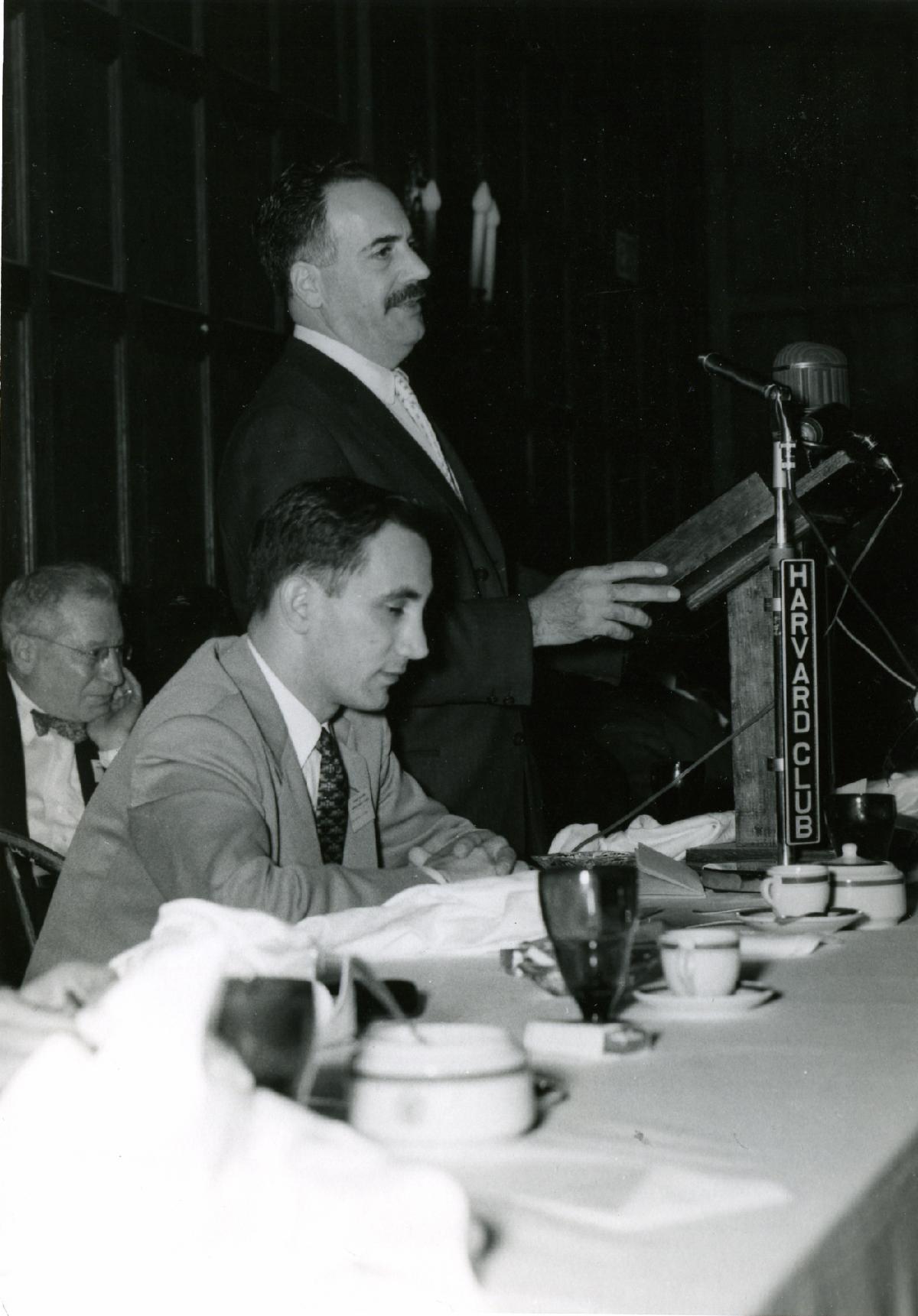
Very likely it was Saroyan's presence that earned the evening a short notice in the October 31, 1955, New York Times. Unlike several landmark early events in NAASR's history, there seems to be no tape recording of the October 30 gala program, nor is there a transcript of Saroyan's remarks.
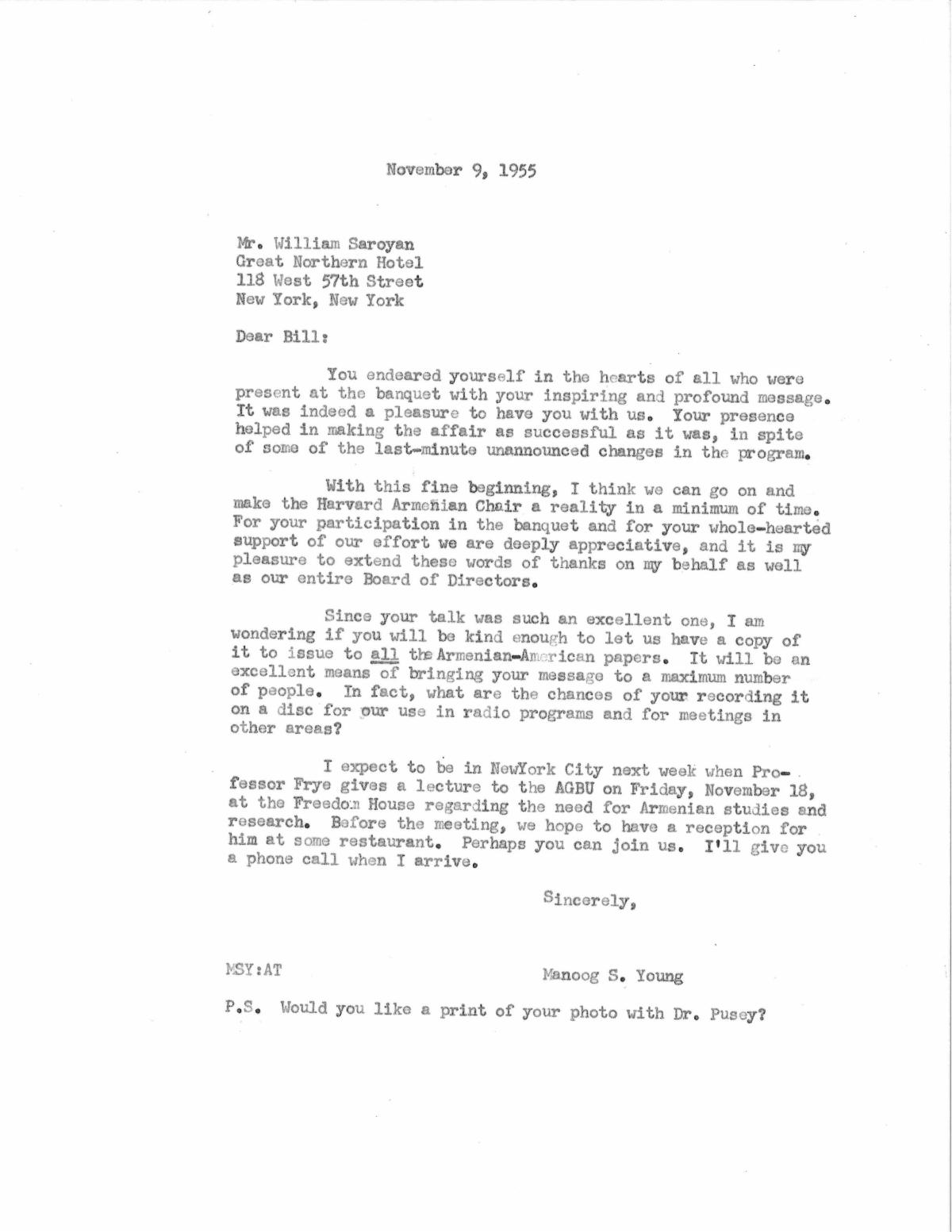
Following the highly successful banquet, on November 9, NAASR Chairman Manoog Young wrote to Saroyan that "[y]ou endeared yourself in the hearts of all who were present at the banquet with your inspiring and profound message. … Since your talk was such an excellent one, I am wondering if you will be kind enough to let us have a copy of it to issue to all the Armenian-American papers. … In fact, what are the chances of your recording it on a disc for use in radio programs and for meetings in other areas?"
Unfortunately, it seems that Saroyan never provided a copy of his remarks (assuming, indeed, that he had written them in advance) nor did he record them. The only record of what was said that night appears to be NAASR's press release issued the week after, which informs us that:
Author-playwright Saroyan said that the program for the advancement of Armenian studies, as outlined by the National Association for Armenian Studies and Research, is the best thing that has come along in generations in the American-Armenian community and is worthy of everyone's whole-hearted support regardless of their religious, political, or other differences. The success of this program will bring to an end "the helpless longing of the human heart for an orderly truth," he maintained.
Communication with Saroyan continued and efforts were made to secure his continued involvement—however, this did not happen. Meanwhile, years passed, Saroyan continued his literary journey and NAASR pursued its goals.
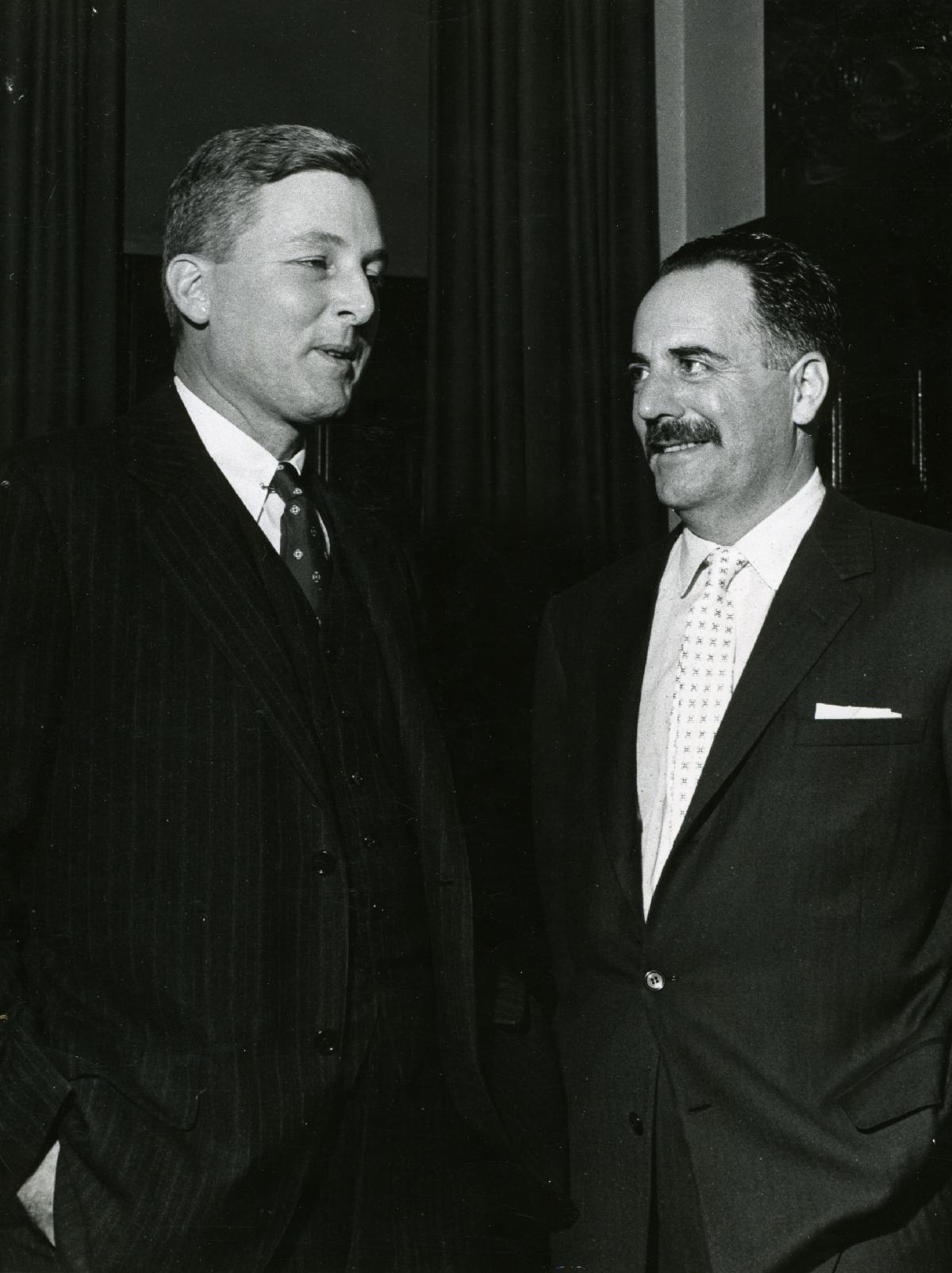
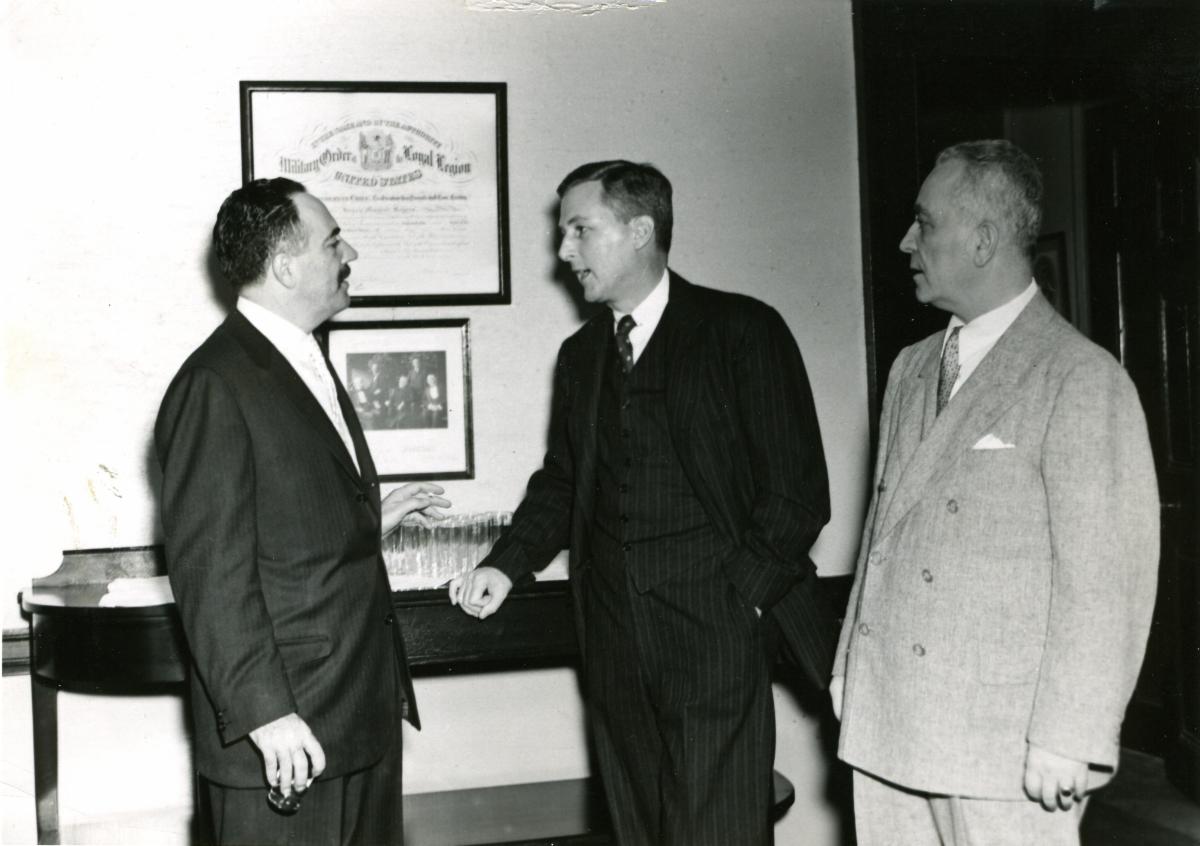
In May 1979, Saroyan was in Boston and paid a visit to NAASR at its headquarters, then on Mt. Auburn Street in Cambridge, and was photographed with Chairman Manoog Young. Although subsequent correspondence attempted to secure Saroyan's participation in NAASR's 25th anniversary celebration in April 1980, it did not come to pass. Saroyan died on May 18, 1981.
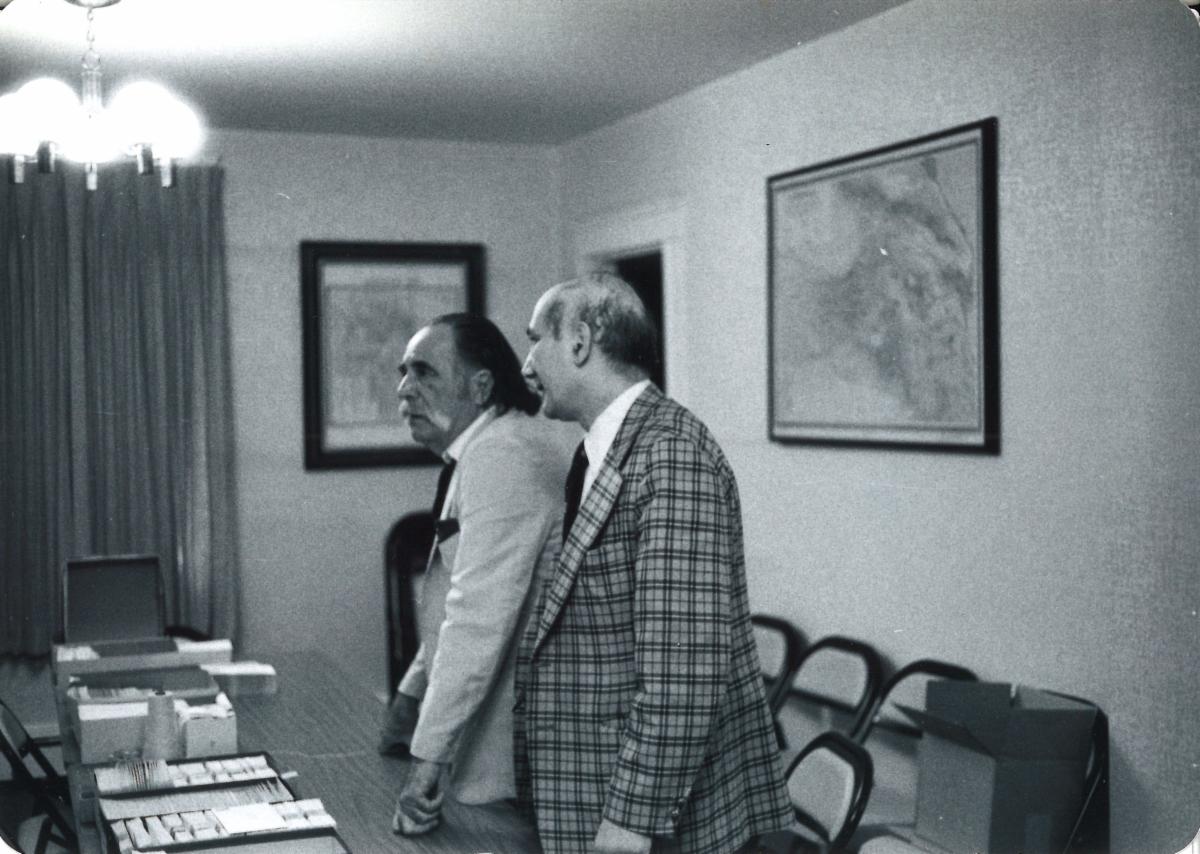
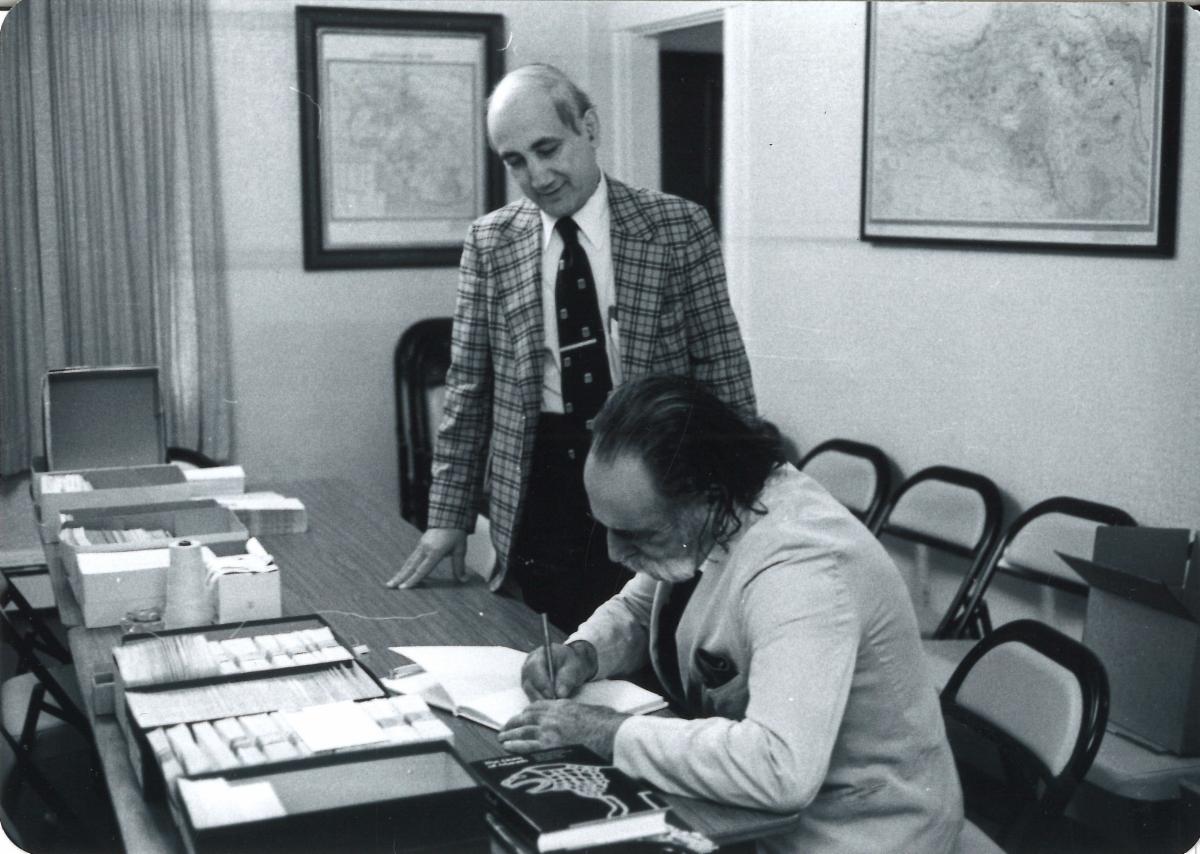
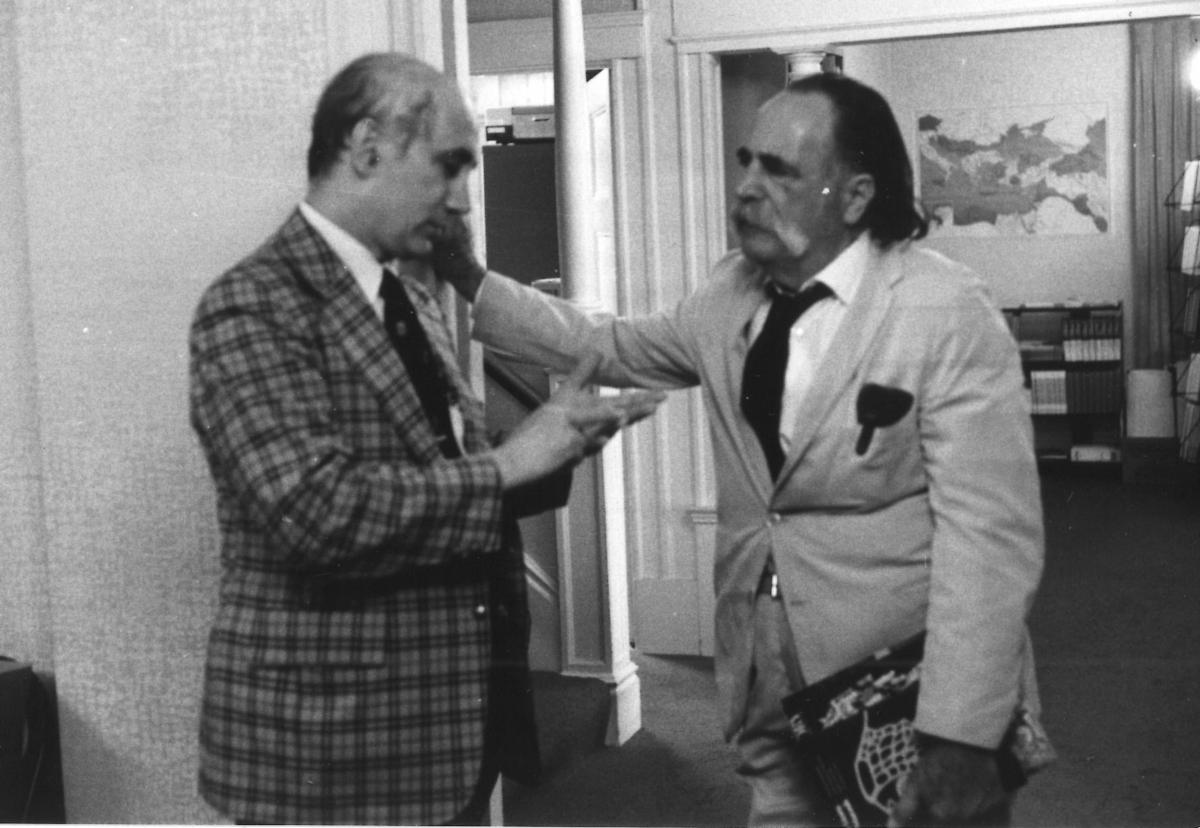
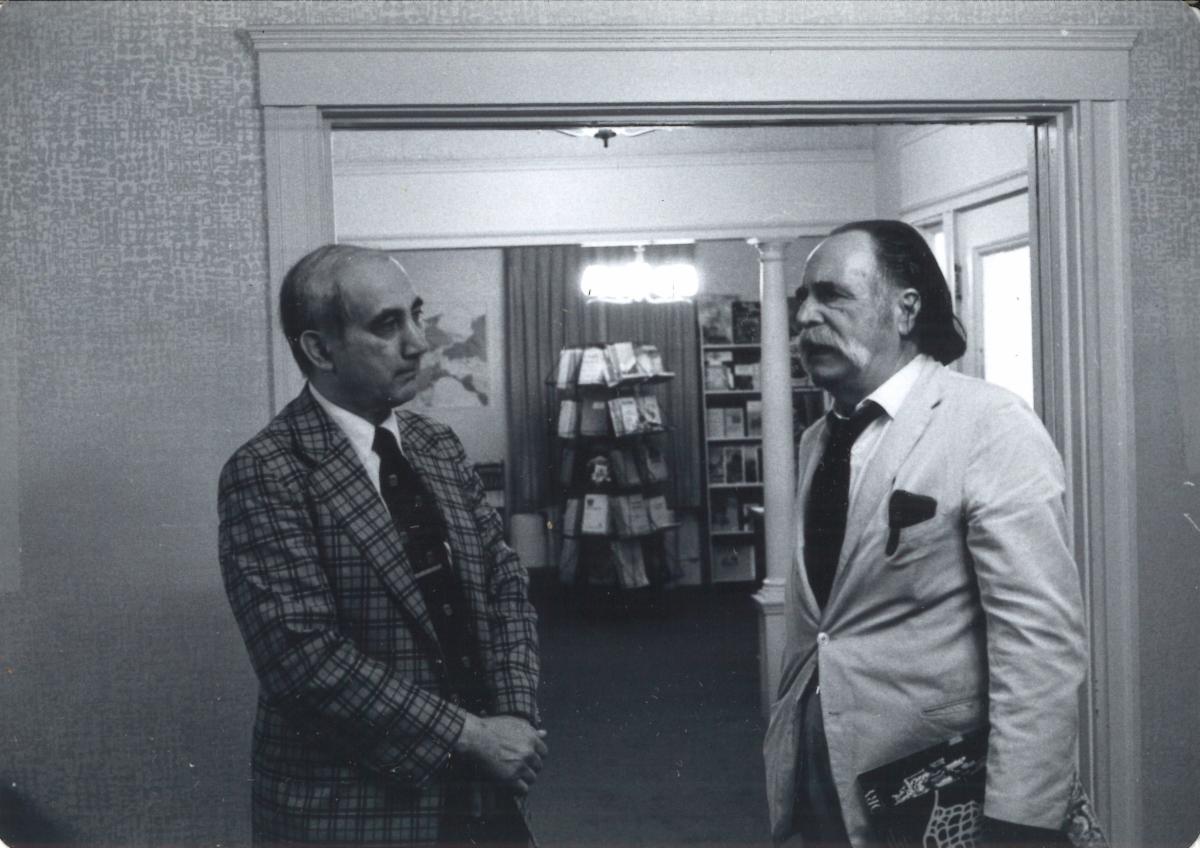
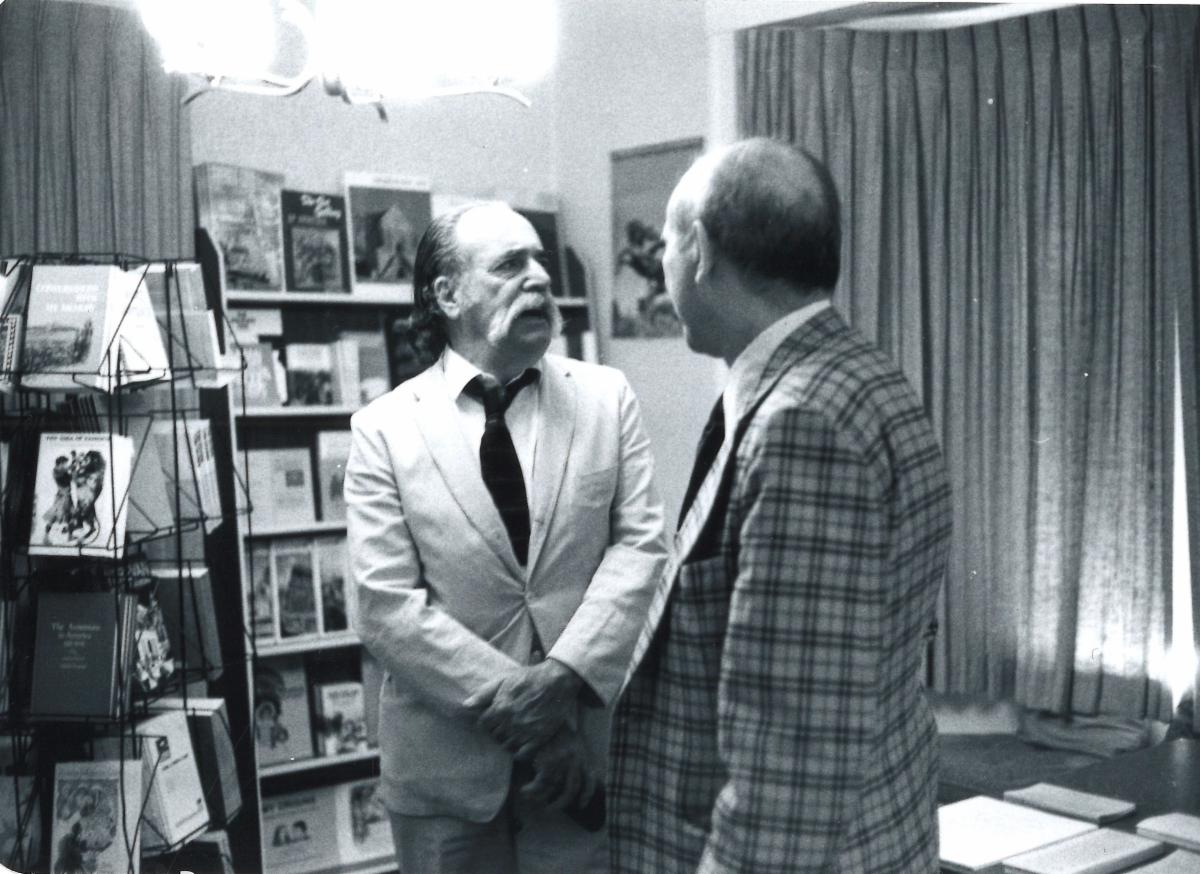
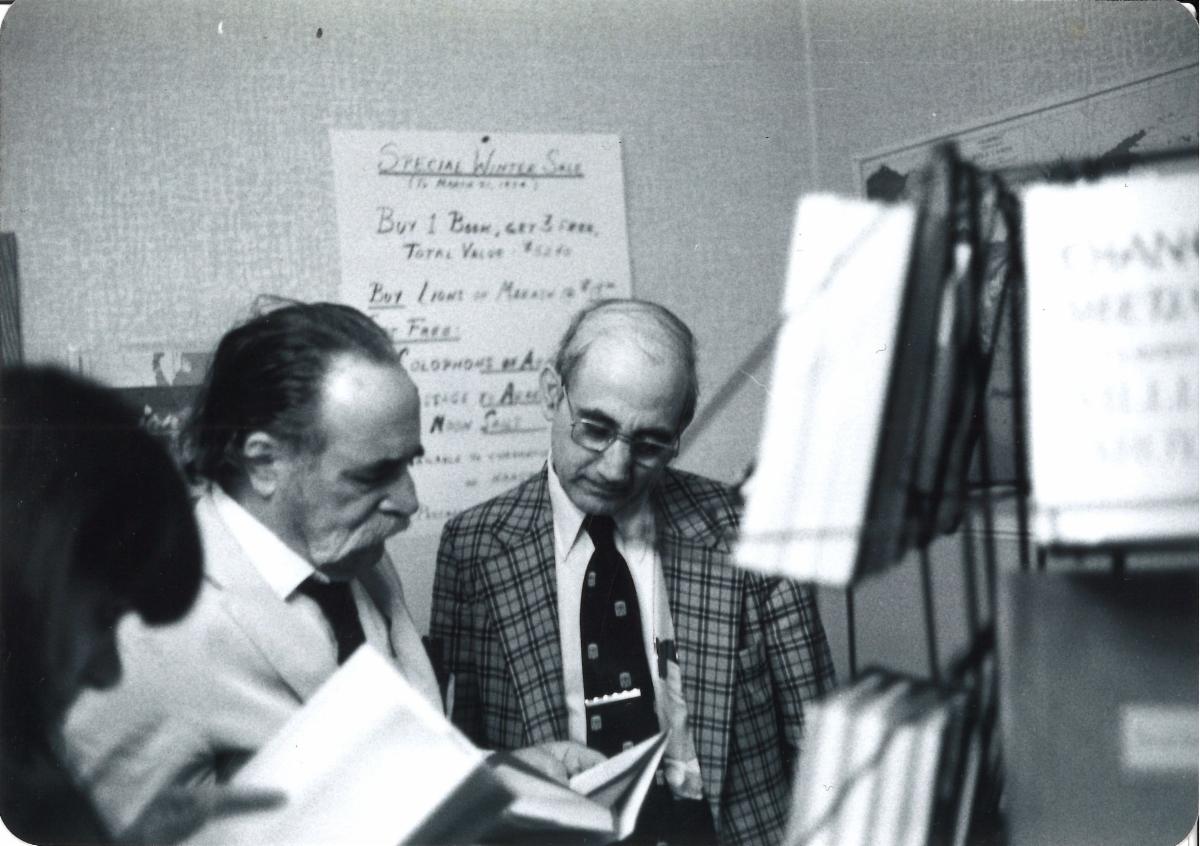
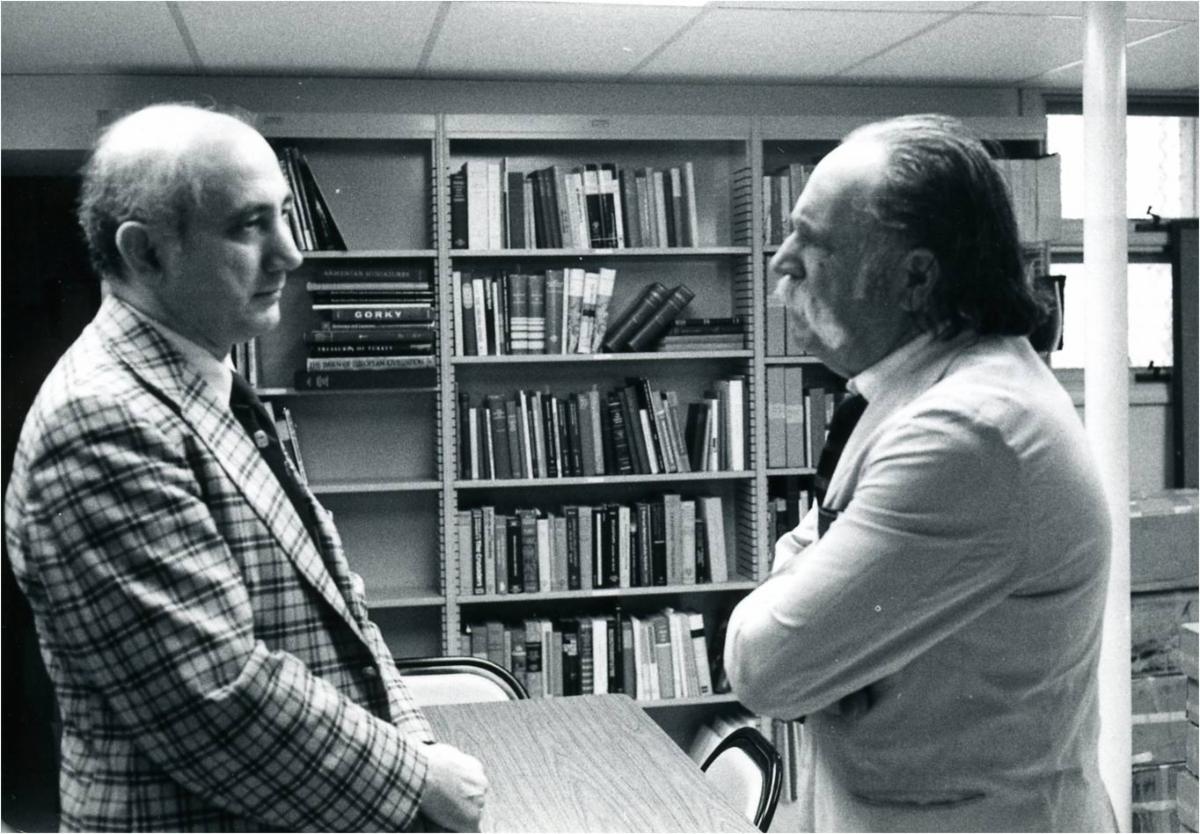
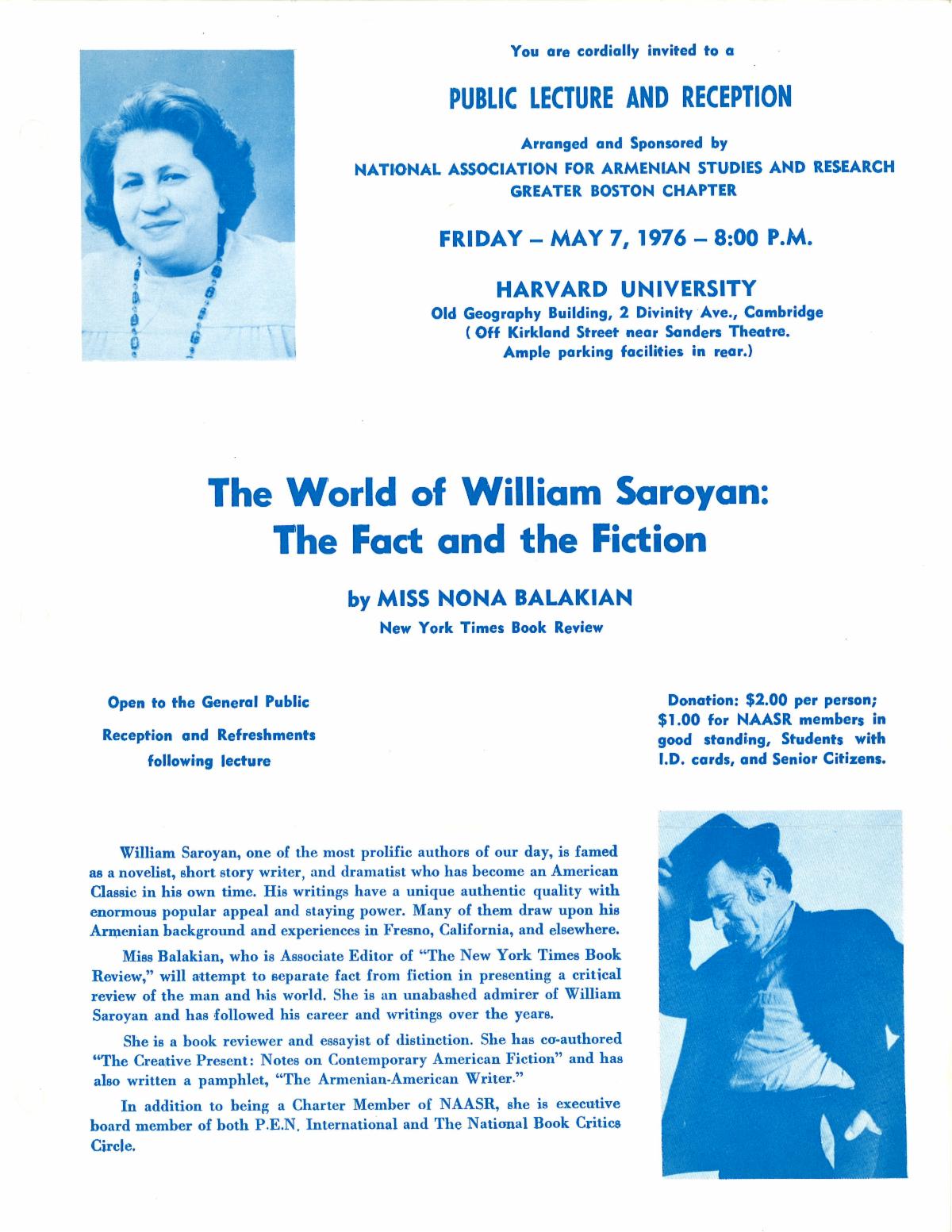
In addition to materials in NAASR's organizational archives relating to Saroyan, some of which are shown here, of course a large number of his publications are also part of our Mardigian Library. A large number, though not all—a surprising fact, given Saroyan's stature, but reflecting the enormous quantity of his output that spanned a nearly 50-year career as a published author.
We recommend the websites of The William Saroyan Foundation and Forever Saroyan for many additional resources on the author.
Publications by William Saroyan
Note: in the works listed below, Western Armenian publications are transliterated per the Library of Congress rules for Western Armenian, Eastern Armenian publications per rules for Eastern Armenian.
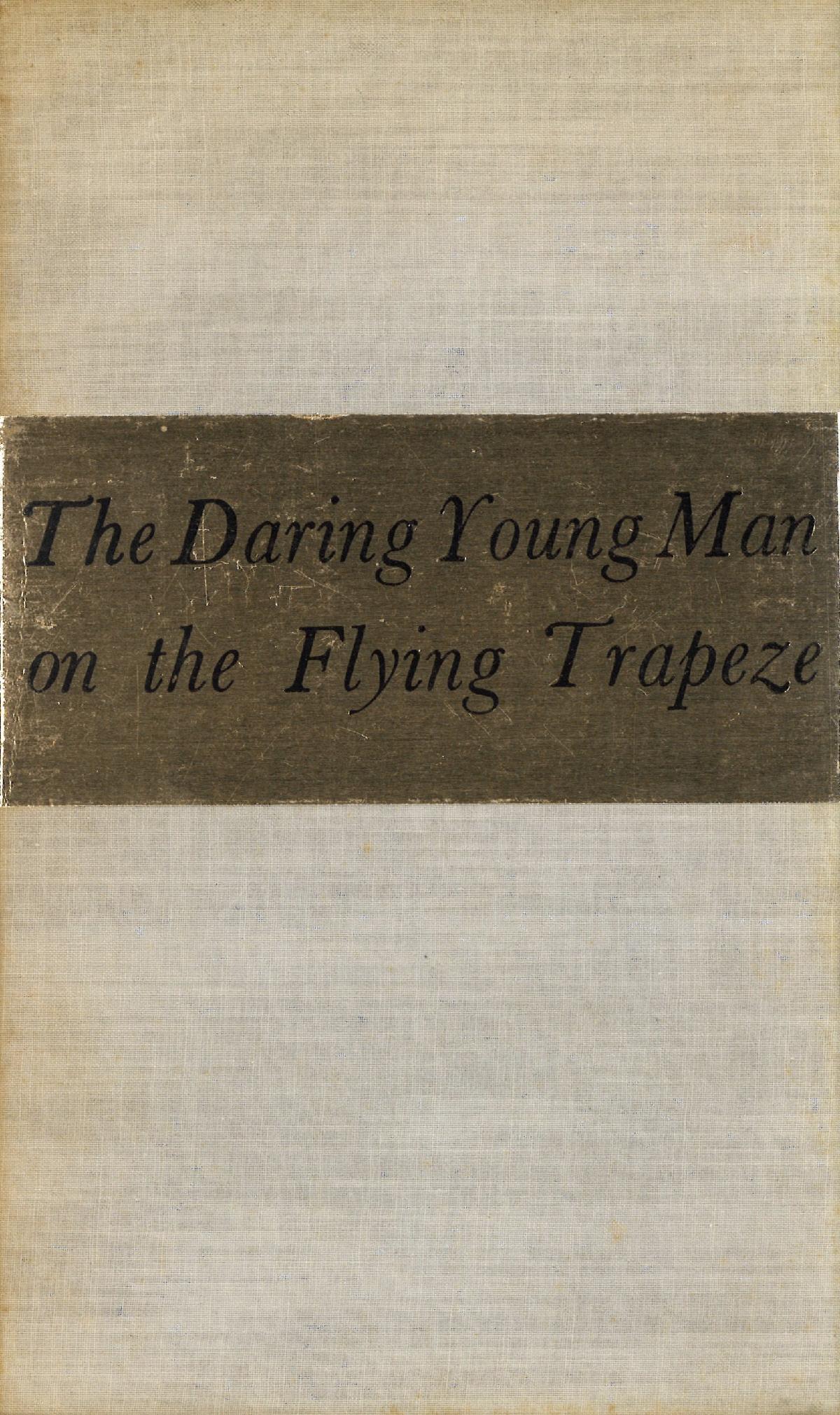
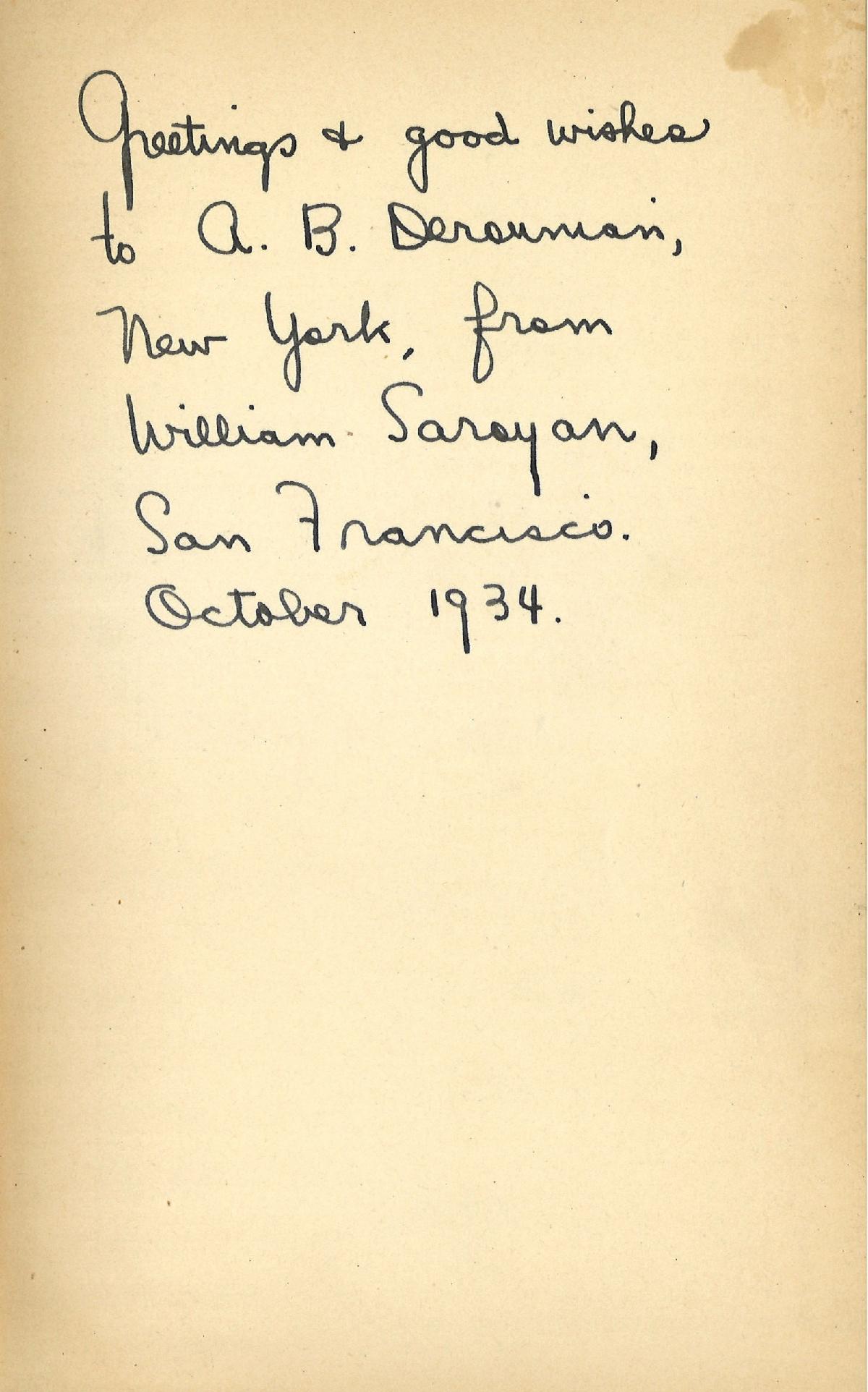
One of two signed copies of Saroyan's first book that entered the NAASR library as part of the Avedis Derounian collection. The Daring Young Man was a surprise bestseller during the depths of the Great Depression and put Saroyan on the American literary map with 26 stories including the title story, "Seventy Thousand Assyrians," "Myself Upon the Earth," and more.
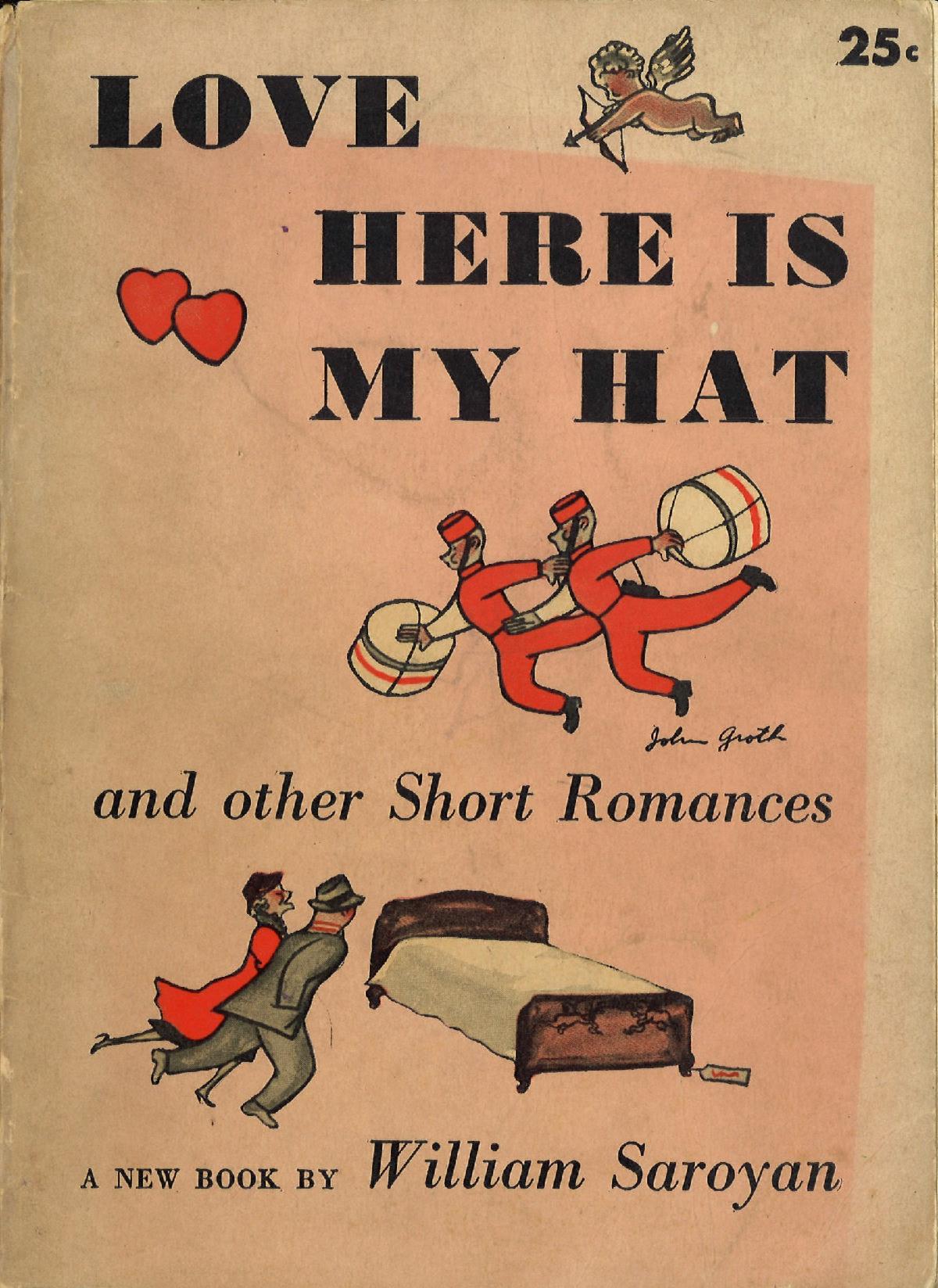
Saroyan's 1930s explosion of creativity produced in rapid succession the collections The Daring Young Man (1934), Inhale and Exhale (1936), Three Times Three (1936), Little Children (1937), The Trouble with Tigers (1938), Love Here Is My Hat (1938), Peace, Its Wonderful (1939), and the plays My Heart's in the Highlands (1939) and the Pulitzer Prize and New York Drama Critics Circle Award-winning The Time of Your Life (1939). The charming cover art for Love Here Is My Hat was done by the noted illustrator John Groth (1908–88).
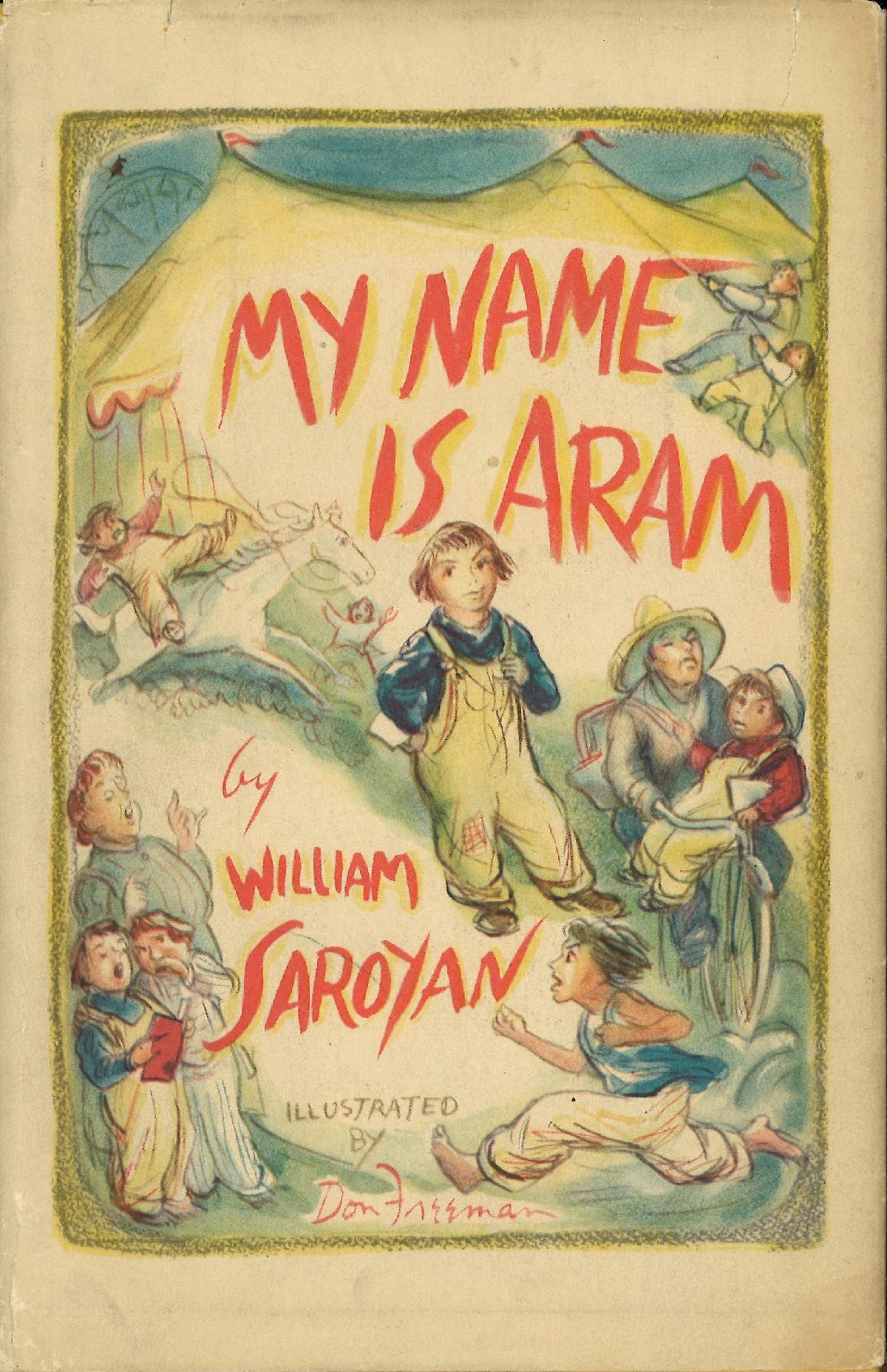
A signed first edition of one of Saroyan's most beloved books. This collection of connected tales centered on young Aram Garoghlanian and his Armenian family and friends in Fresno, California. Saroyan's author's note states: "The writer returns these pleasant memories to the world at Fresno, California, from the year 1915 to the year 1925 (from the time he was seven years old and was beginning to inhabit the world as a specific person to the time he was seventeen years old and had forsaken his native valley for some of the rest of the world), and to members of his immediate family in that world during those years." The beautiful cover and book illustrations are by the great Don Freeman (1908–78), whose work also adorns The Human Comedy and who went on to a long and successful career as a children's book author and illustrator.
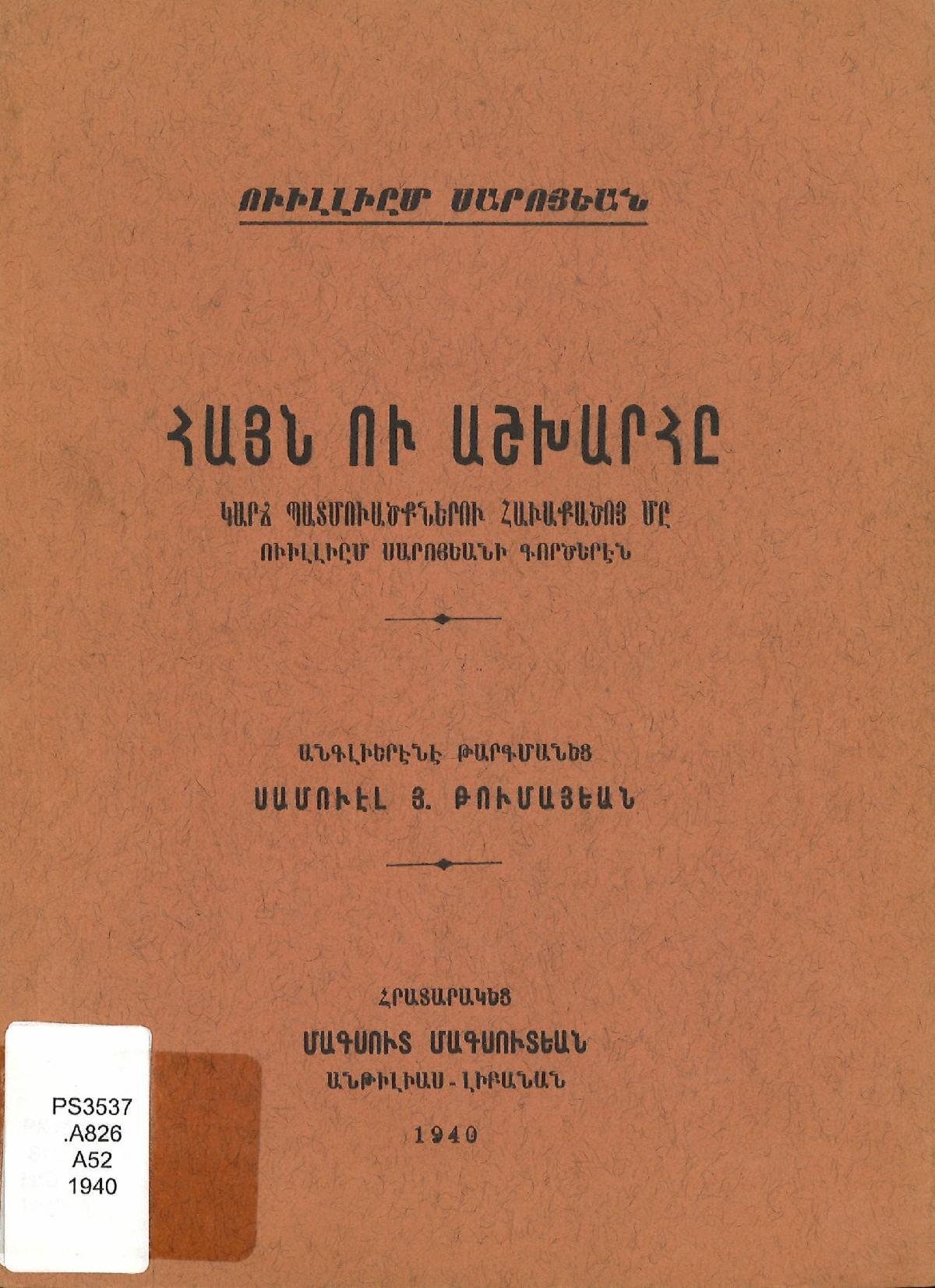
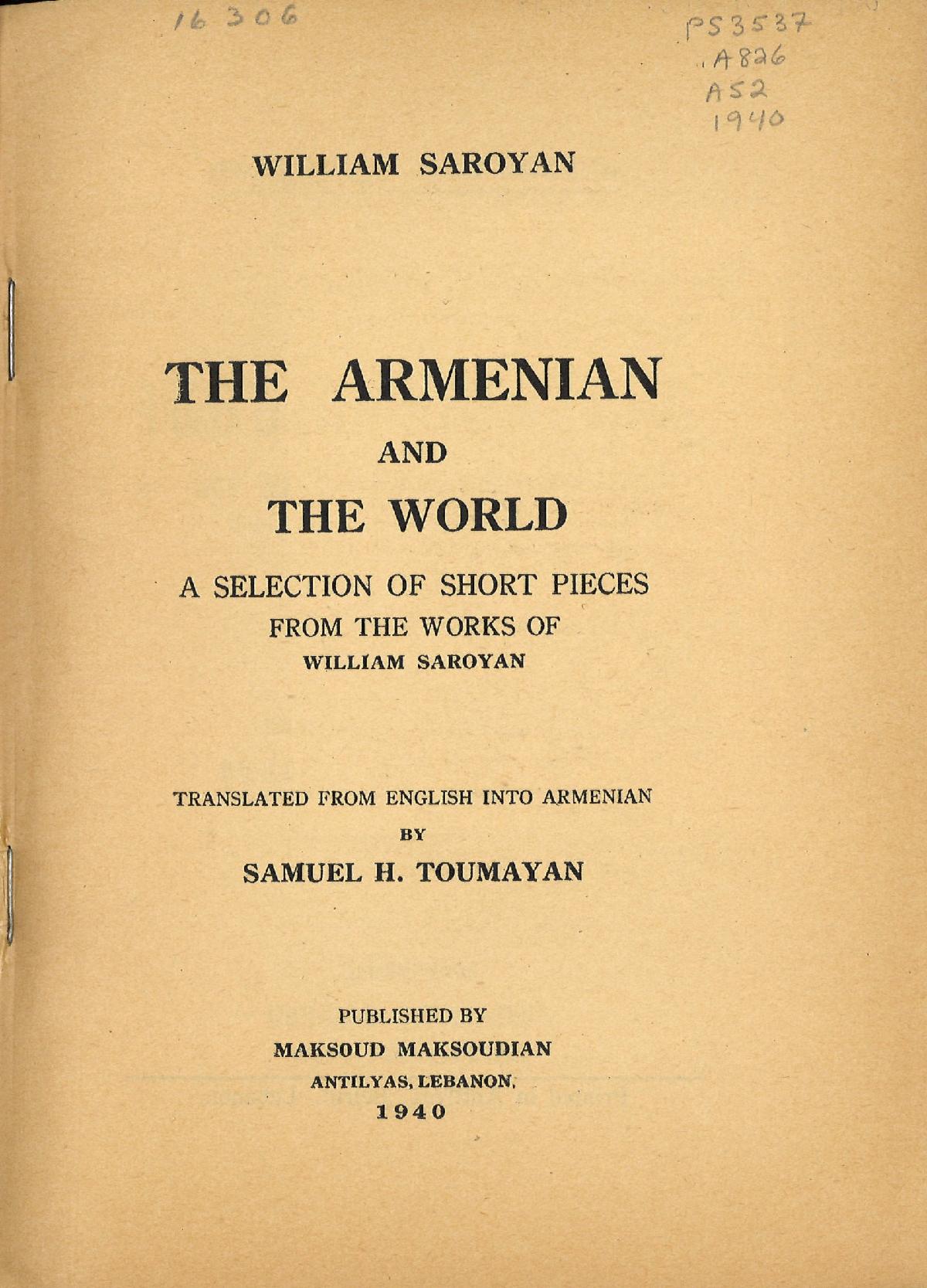
Very likely the first translation into Armenian of some of Saroyan's work, undertaken by Samuel H. Toumayan, son of Rev. Haroutune Toumayan of Boston, later the publisher and editor of the independent Nor Ashkhar newspaper, and a NAASR founding member. Hayn u Ashkarě offers Western Armenian versions of 10 stories. The collection (for which the cover and English-language title page are shown) features a preface in English by Saroyan, who writes that "Although I write in English, and although I am an American by birth, I regard myself as an Armenian writer. … This small book contains some of my writing. I am pleased that something of what I have said, and am saying, shall be here returned to the language of that spirit which impelled me to speak. To the beautiful language of Armenia."
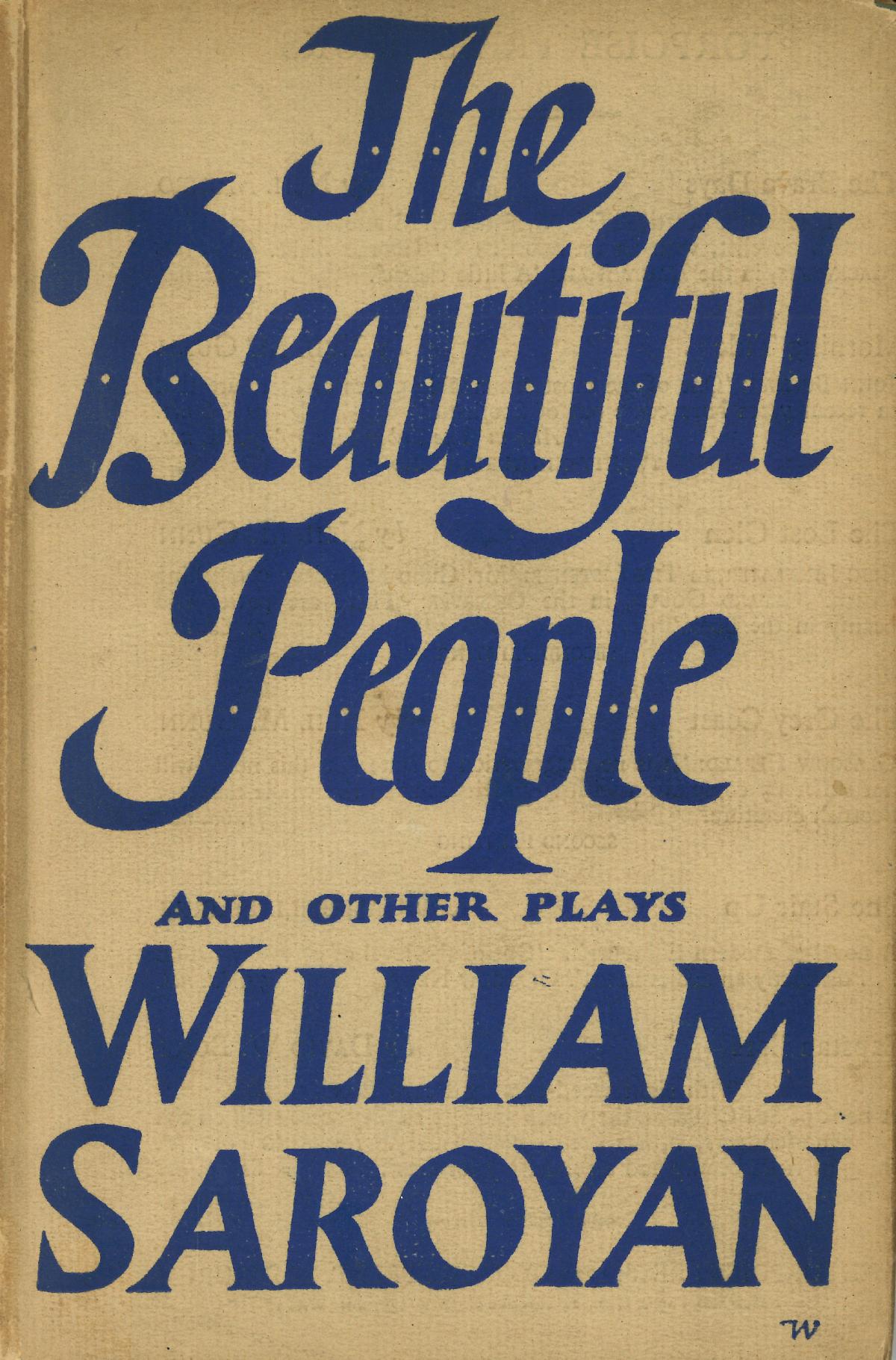
Fourth printing of the first British edition of this title. The lead play, The Beautiful People, was first performed in New York at the Lyceum Theatre in 1941. The volume also contains the short plays Sweeney in the Trees and Across the Board on To-morrow Morning.
![Badmuatsk‘ner [Stories], cover](https://files.constantcontact.com/0bcbcd15701/f2476faa-87c4-41c5-8aeb-df107333d67e.jpg?rdr=true)
This copy of the translation of Saroyan's best-seller The Human Comedy (upper right) was formerly owned by NAASR Founding Member Hagop Atamian, and is inscribed by the translator, A. Gesar, to the noted Armenian author Levon Shant (1869–1951), whose signature is also on the title page.
![Martgayin Gadagerkut‘iwn [The Human Comedy], inscription](https://files.constantcontact.com/0bcbcd15701/b8d8a8fa-c939-4bdc-bb75-1e5d762591dd.jpg?rdr=true)
![Martgayin Gadagerkut‘iwn [The Human Comedy], cover](https://files.constantcontact.com/0bcbcd15701/3105a5fb-513c-4cf1-81d3-9f8a5bf7c602.jpg?rdr=true)
![Anuns Aram Ē [My Name Is Aram], cover](https://files.constantcontact.com/0bcbcd15701/ec000f52-1115-4372-bd84-c95bd4da03aa.jpg?rdr=true)
![Dasě Nor Badmuatsk‘ner [Ten New Stories], cover](https://files.constantcontact.com/0bcbcd15701/3485ee3b-6de8-48ea-a170-a255656d58a1.jpg?rdr=true)
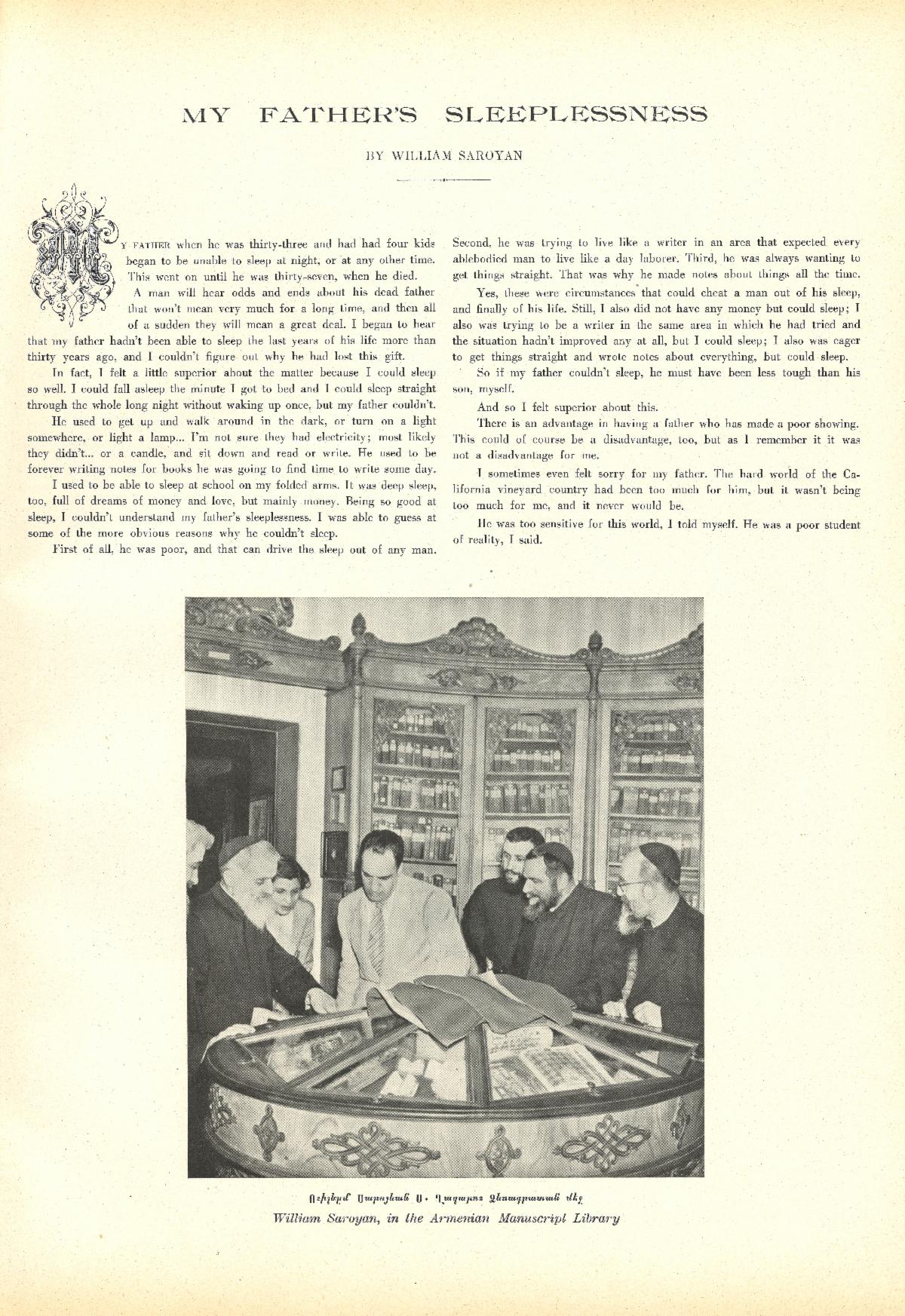
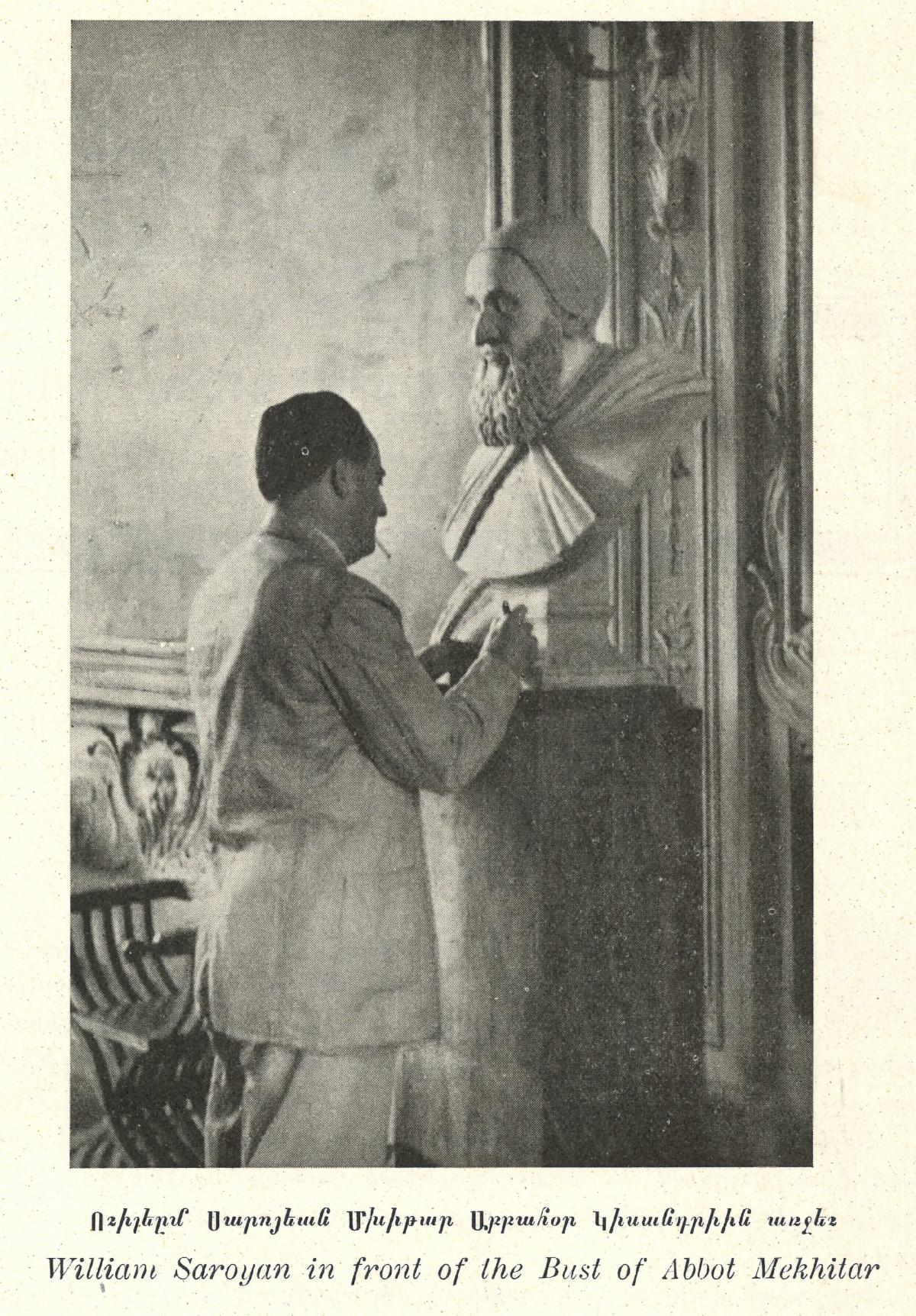
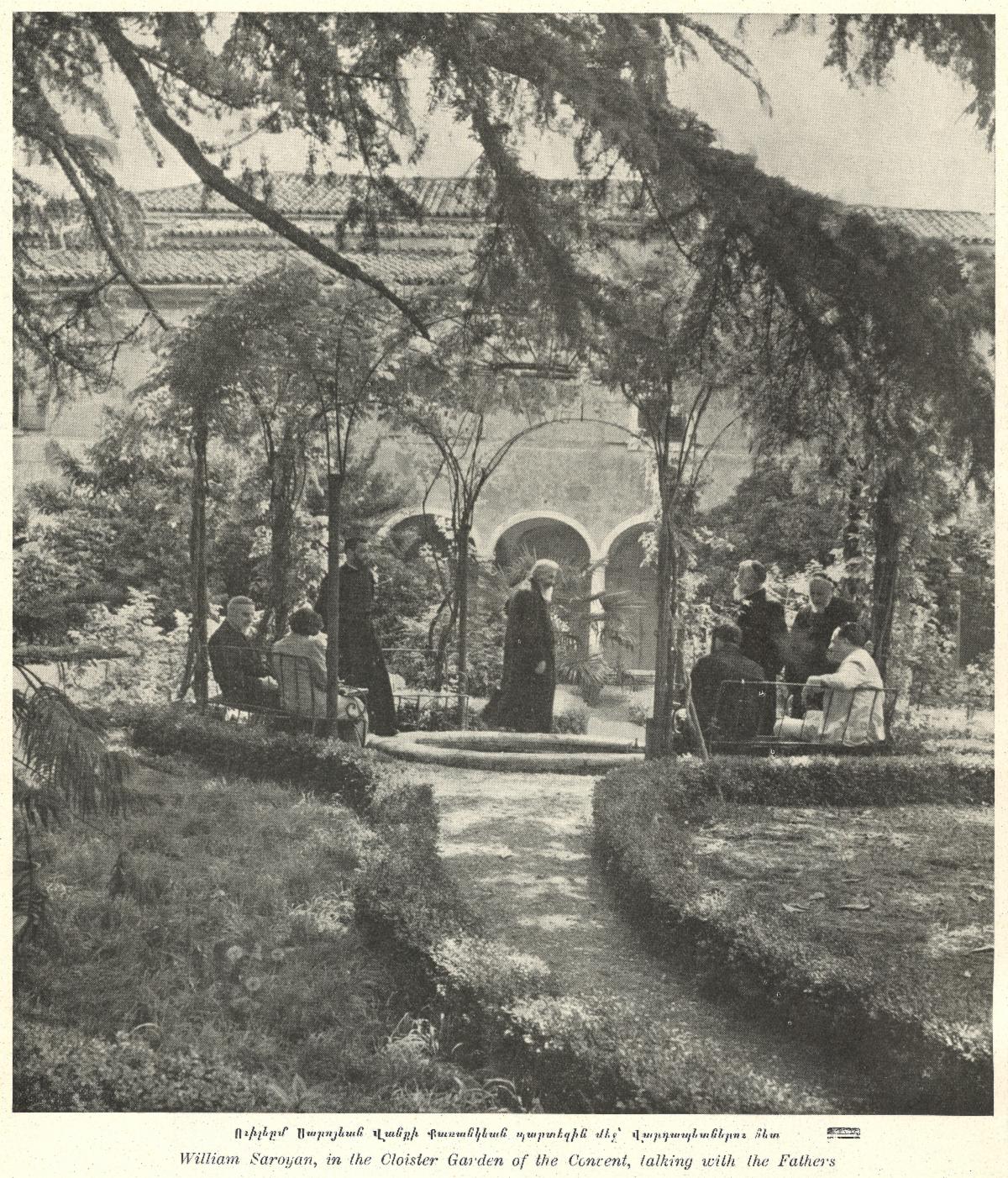
Saroyan's short story "My Father's Sleeplessness" was published in the 1950 issue of Keghuni, the beautifully illustrated periodical issued by the Mekhitarists in Venice at irregular intervals between 1901 and 1950. The story is accompanied by several photos of Saroyan during a visit to San Lazzaro. "My Father's Sleeplessness" is, to the best of our knowledge, not anthologized in any Saroyan collection. To read the story, click here.
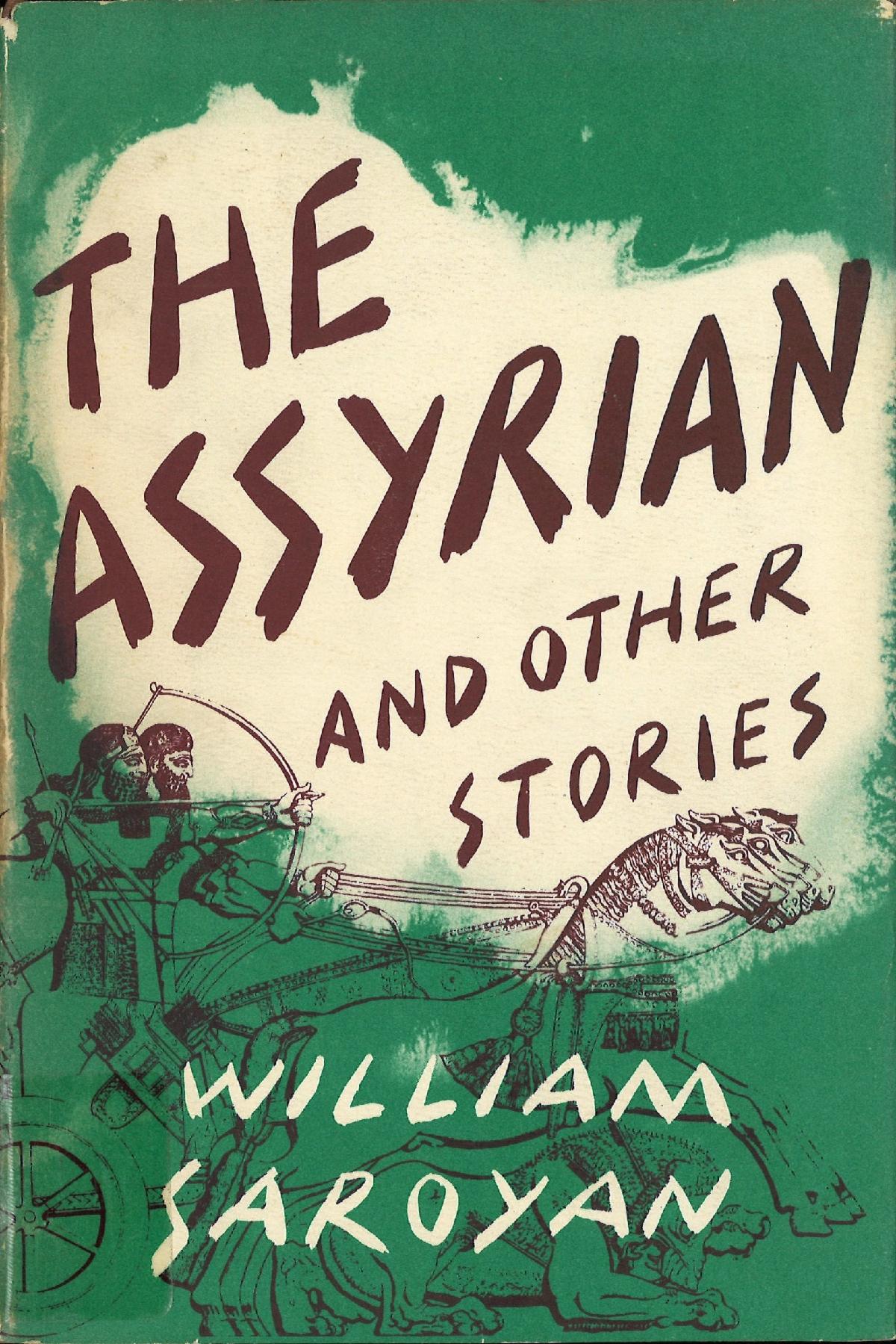
First edition of Saroyan's first volume of short stories since Dear Baby (1944).
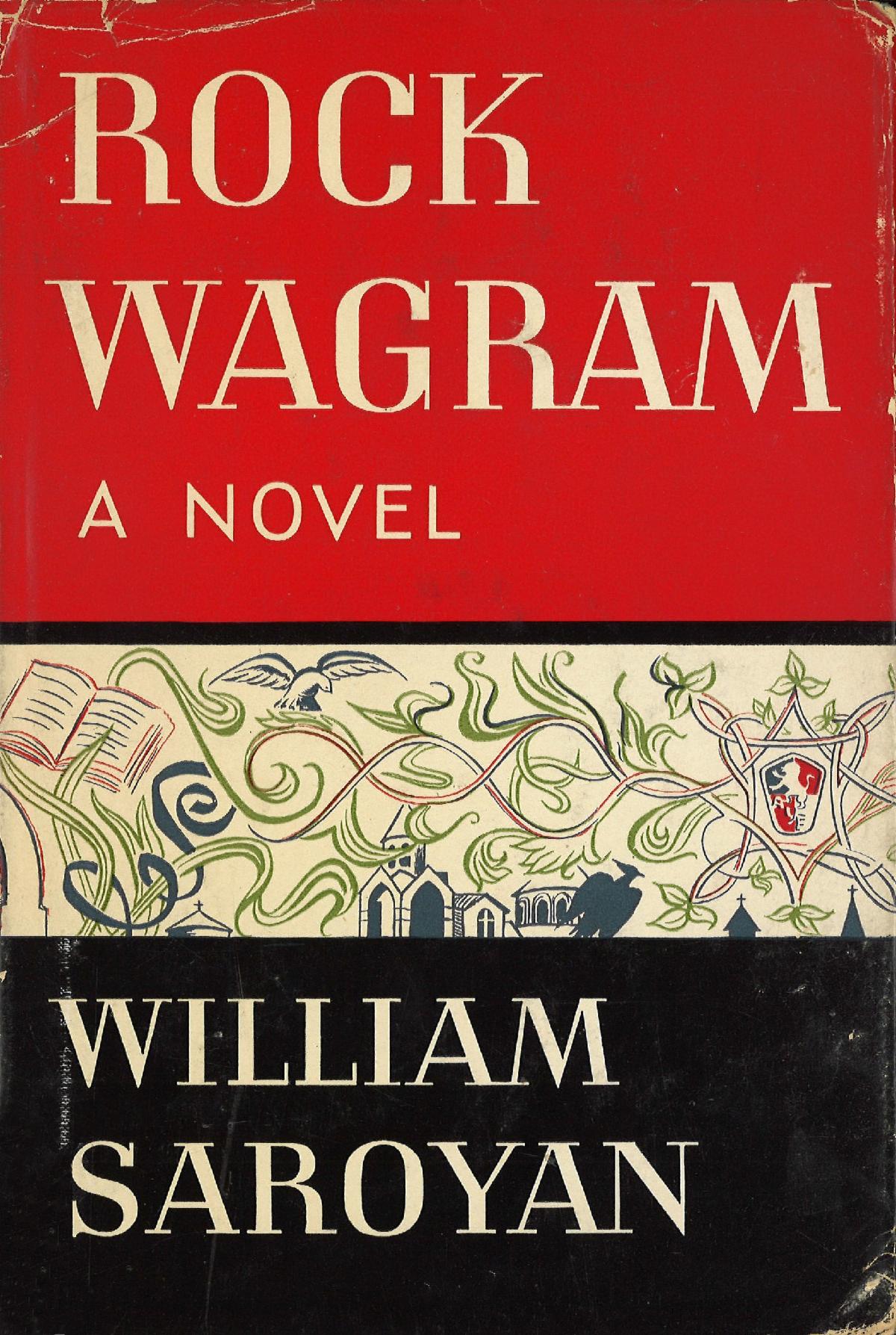
After The Human Comedy in 1943, Saroyan never again enjoyed such commercial success with any of his novels. Nevertheless, they are of considerable interest, and Rock Wagram is among the more successful efforts. This copy is one of several included here that came from the collection of long-serving NAASR Board Member Robert Bejoian.
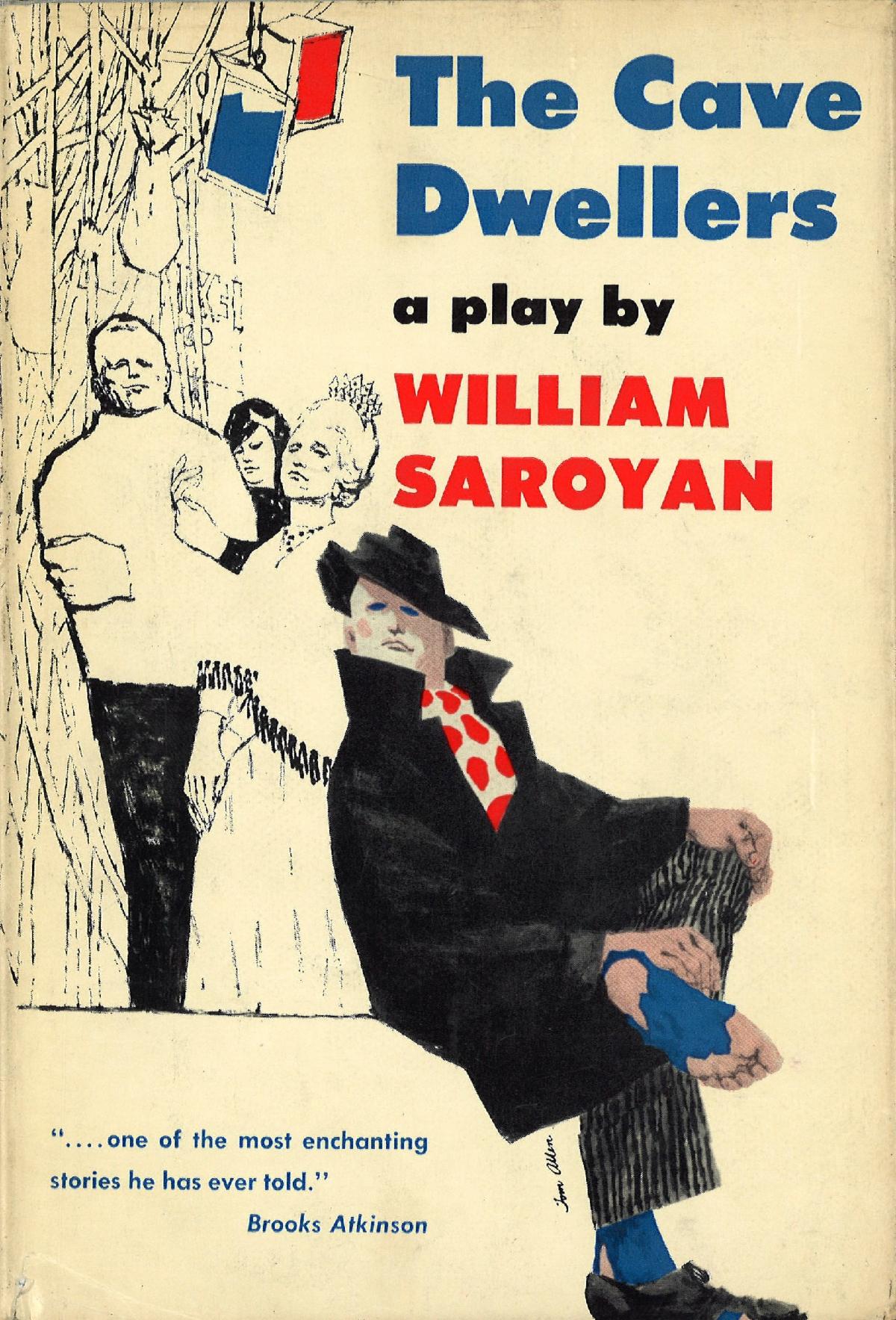
The Cave Dwellers was Saroyan's first play to be produced on Broadway since 1943, and one of his best-received dramas.
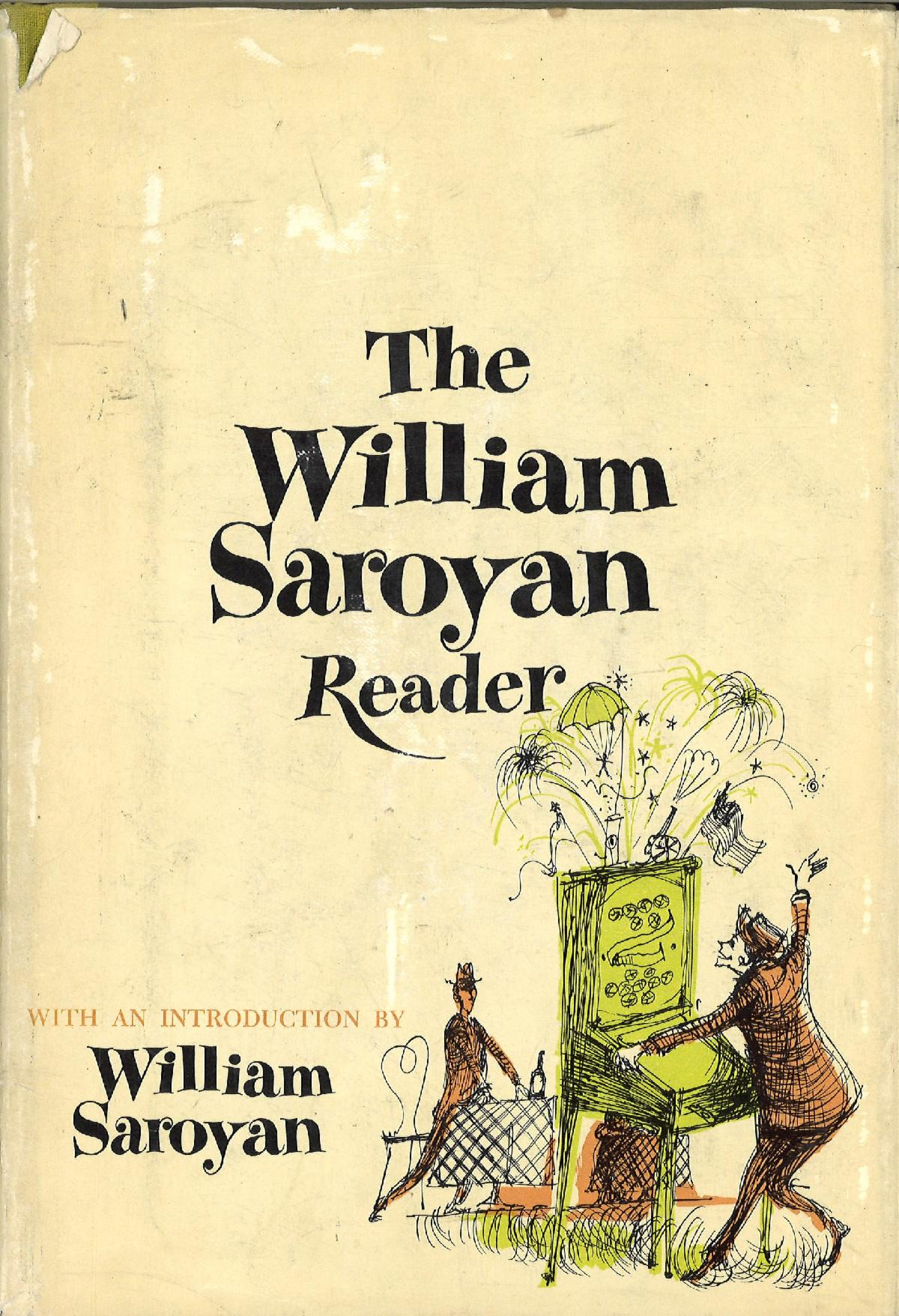
Of the numerous anthologies of Saroyan's work, this is probably the best known. It is prefaced by a short essay by Saroyan, "Why I Write," that describes the approach of "a man who is determined to understand the meaning of his own life, and to be prepared to write about it."

![Martkayin Katakergut‘yun [The Human Comedy], cover](https://files.constantcontact.com/0bcbcd15701/08654e96-b626-4946-b9d5-f8adaba2566b.jpg?rdr=true)
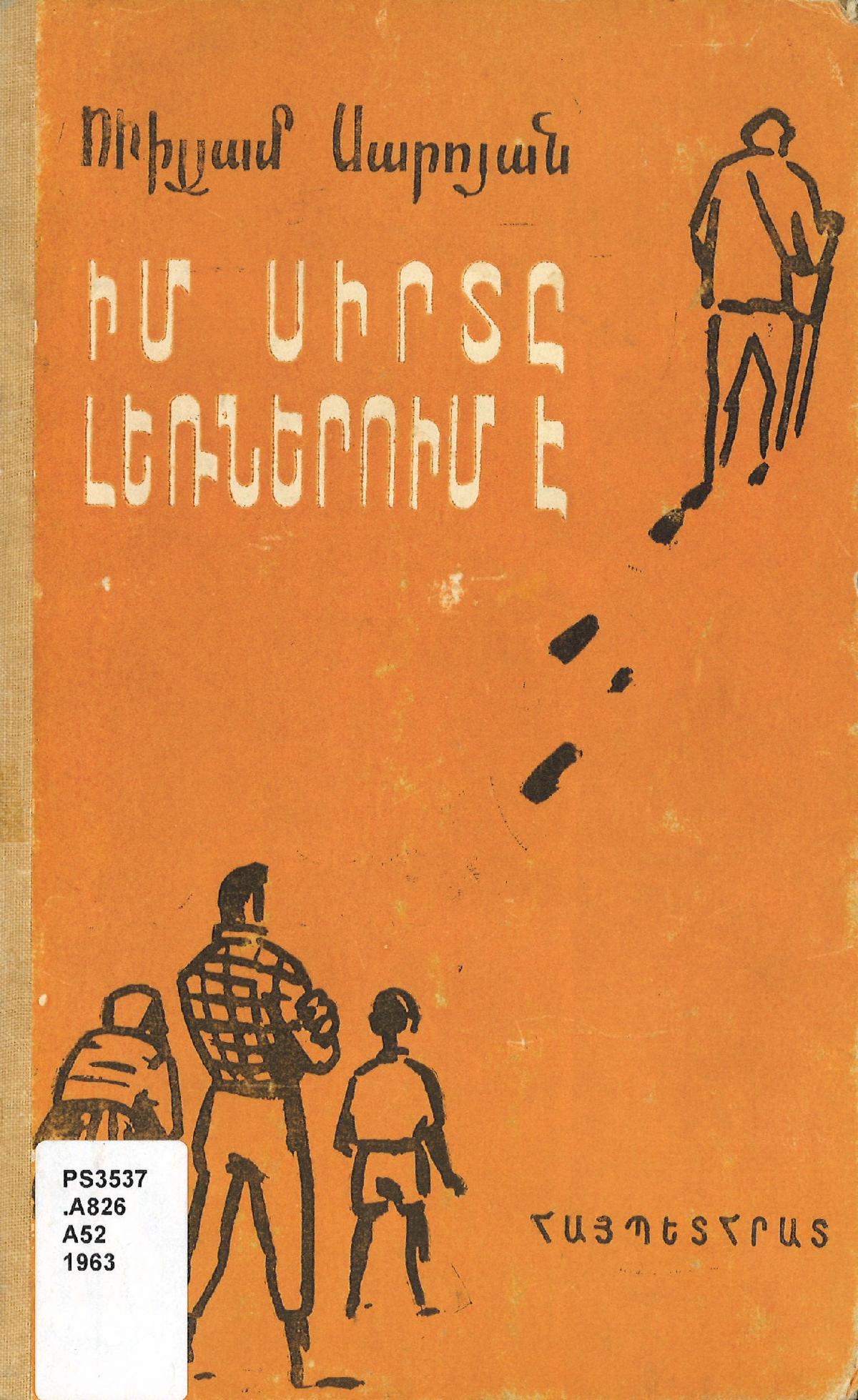
It is not entirely clear to us if these are the first Eastern Armenian-language translations of Saroyan published in Soviet Armenia, although we have not found earlier ones. The 1963 volume includes translations of his plays My Heart's in the Highlands [Իմ Սիրտը Լեռներում Է] (Դաշտենց), Hello Out There [Էյ, Ո՞վ Կա Այդտեղ] (Դաշտենց), The Time of Your Life [Ձեր Կյանքի Ժամանաը] (Ալաջաջյան) and Jim Dandy [Ջիմ Դանդի] (Քեշիշյան).
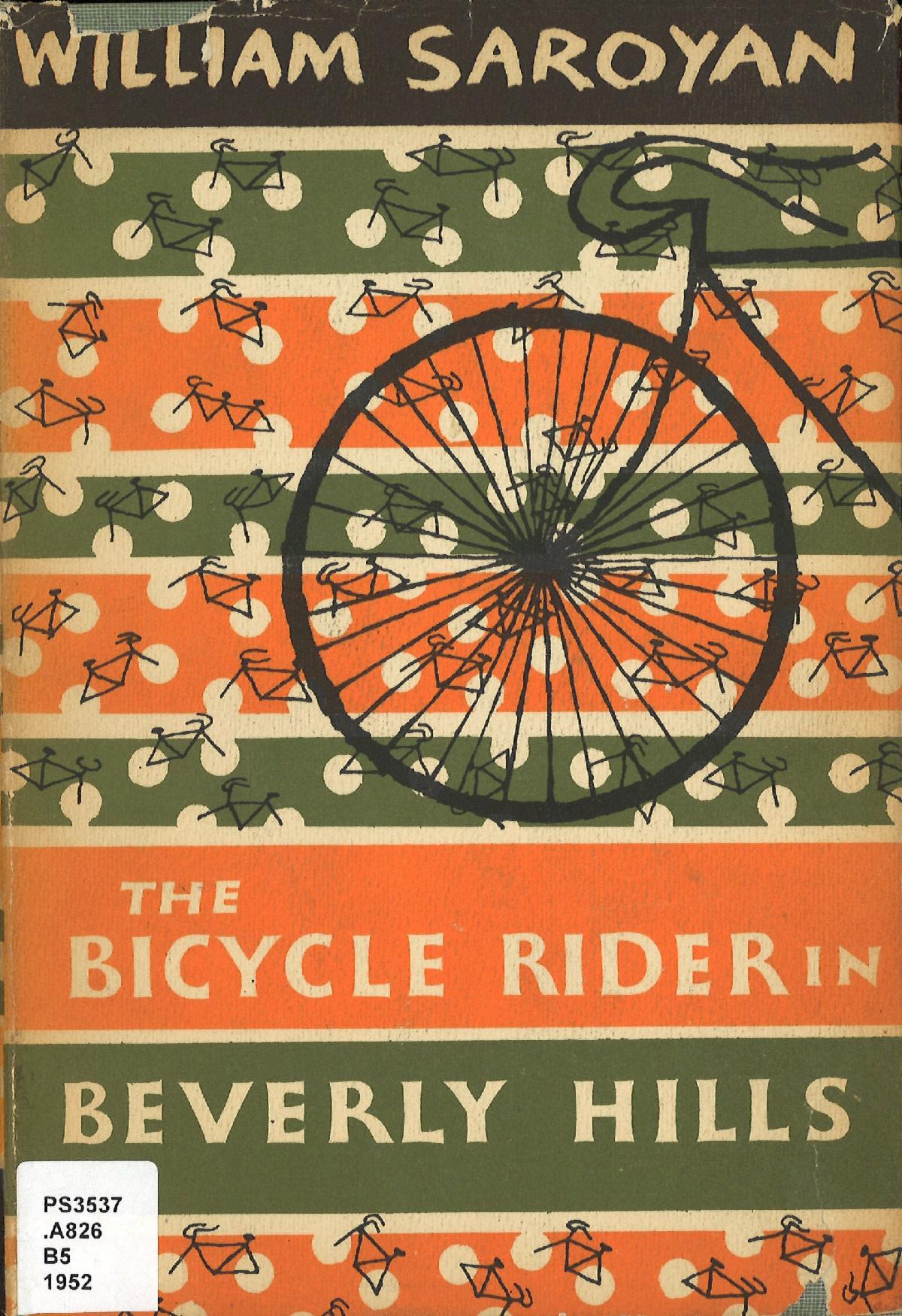
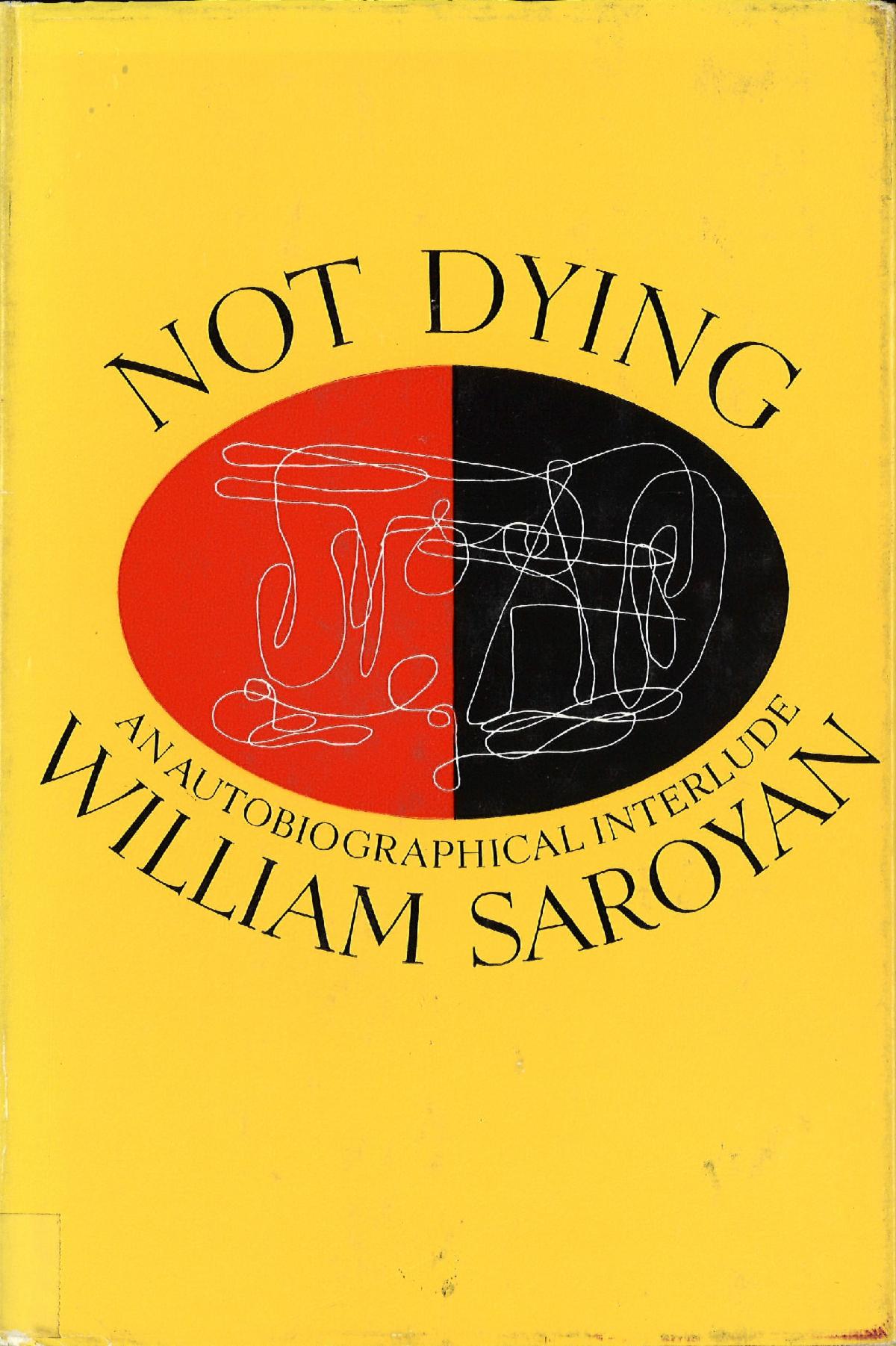
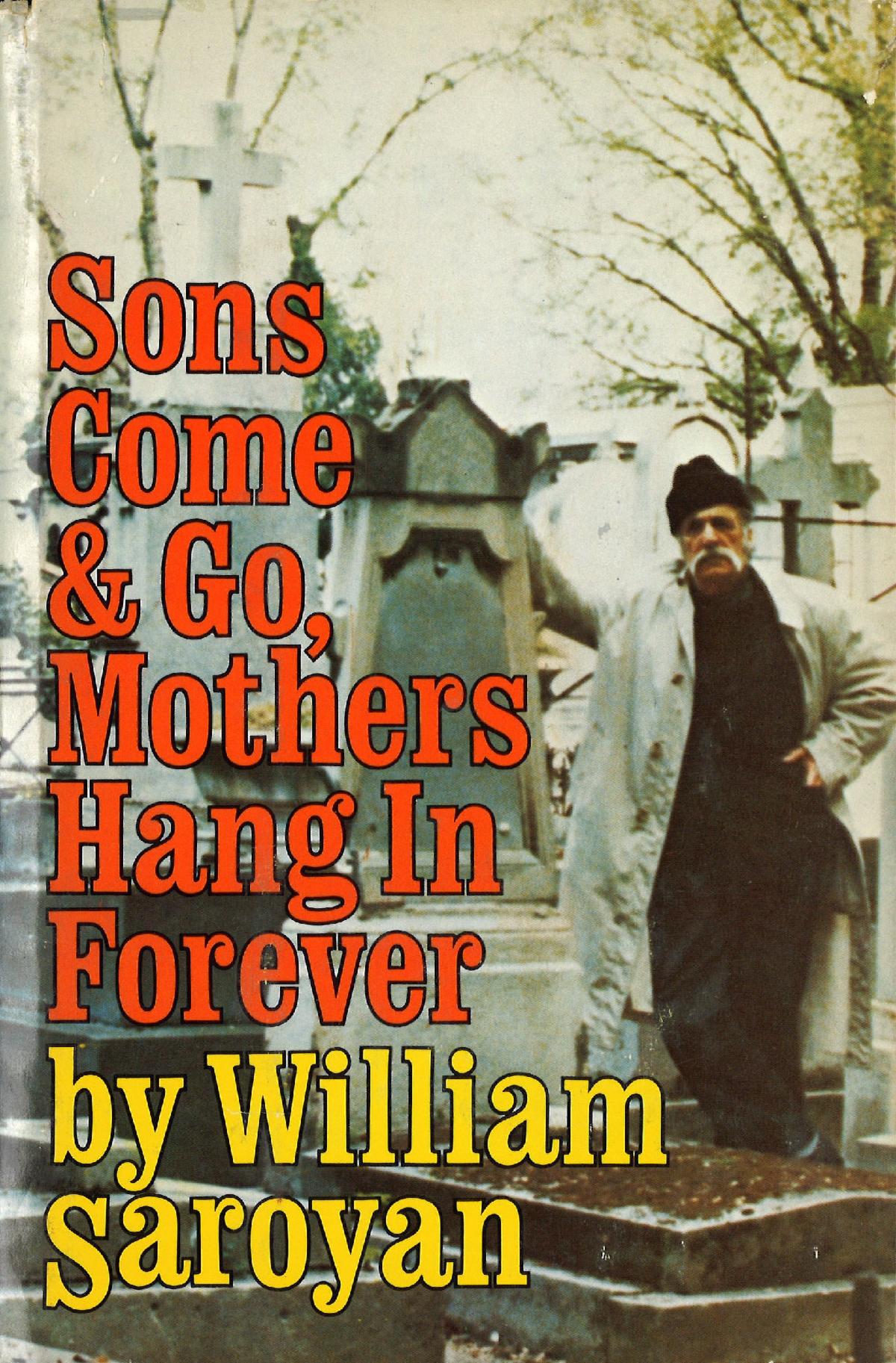
As Saroyan wrote in the essay "The Writer on the Writing," included as a kind of introduction to The Assyrian (1950): "Between the essay and the short story, though, it seemed to me there existed a form or formlessness which would permit me to write. … At last I decided that either I myself was the beginning and end of the matter, or there was no matter at all. The way I stayed alive was interesting or it wasn't."
And so, beginning with The Bicycle Rider in Beverly Hills, much of the remaining three decades of his life and career was devoted to autobiographical works including Here Comes/There Goes You Know Who (1962), Not Dying, Letters from 74 Rue Taitbout or Don't Go But if You Must Say Hello to Everybody (1969), Short Drive, Sweet Chariot (1966), Days of Death and Life and Escape to the Moon (1970), Places Where I've Done Time (1972), Sons Come & Go, Mothers Hang in Forever, Chance Meetings (1978), Obituaries (1979), and the posthumous Births.
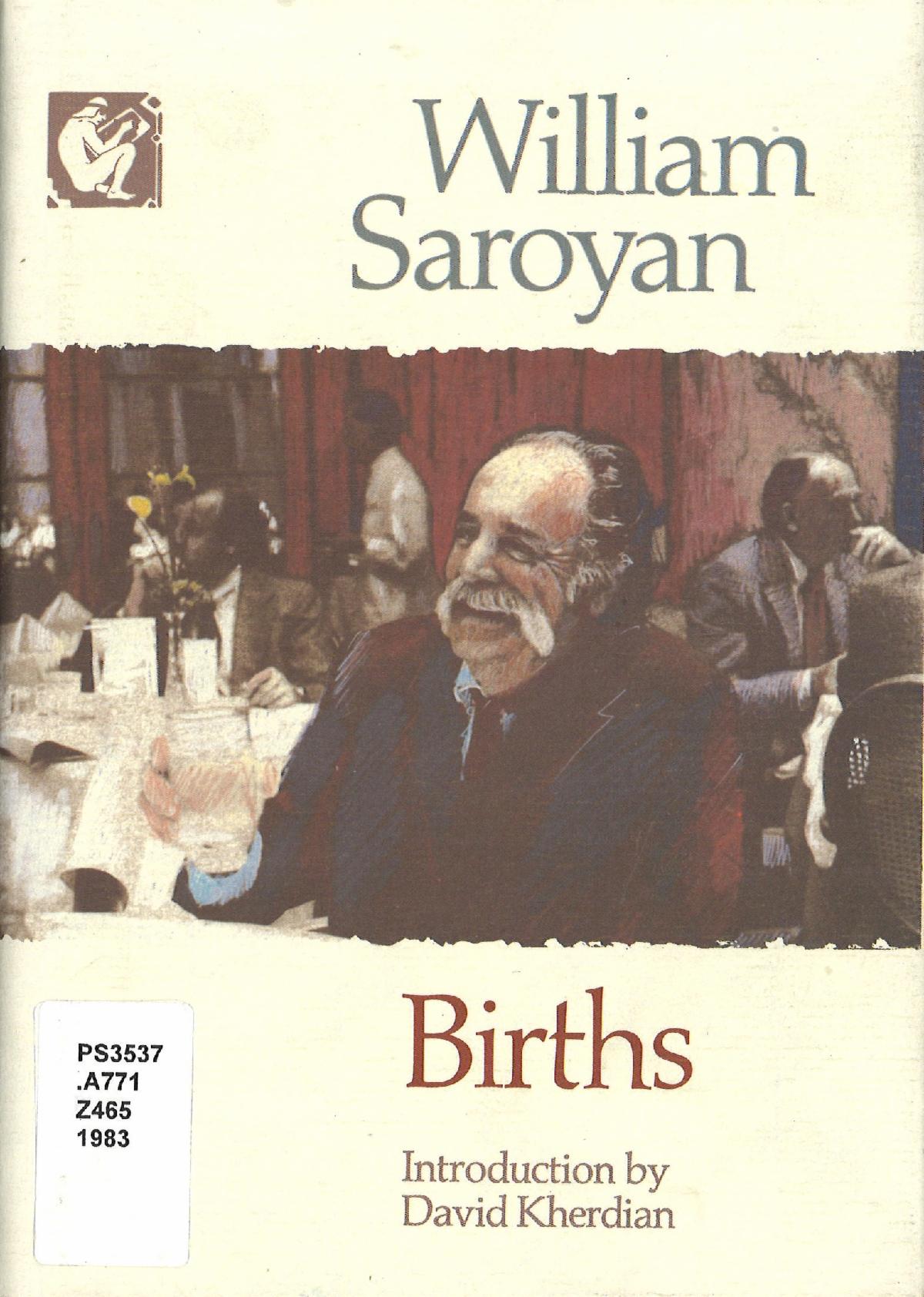
Other Saroyan-Related Materials
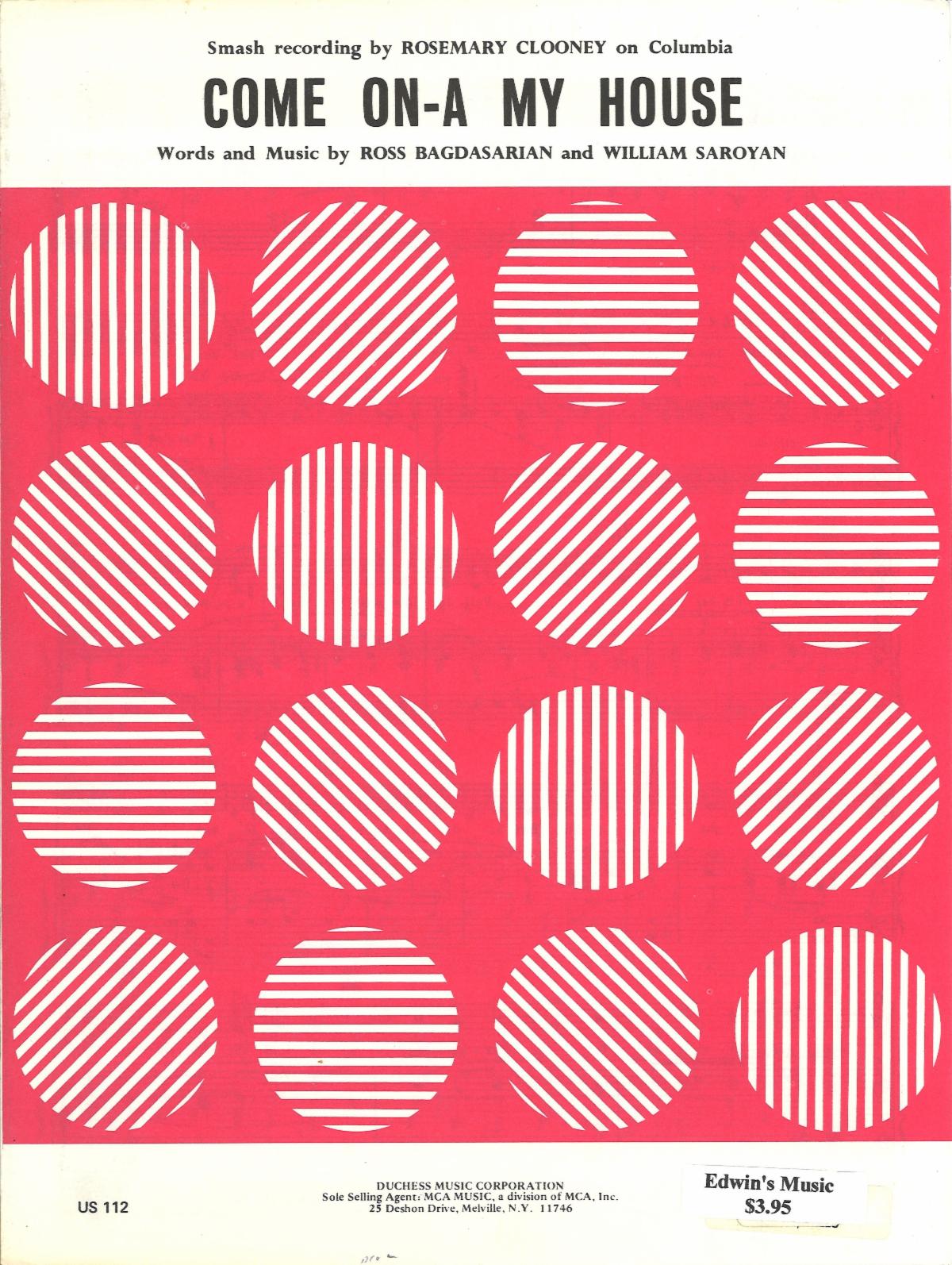
Sheet music for the song written by Saroyan and his cousin, Ross Bagdasarian, which became a "smash recording" for Rosemary Clooney in 1951. See our Library Treasures feature "'Come On-a My House' and the Armenian-American Pop Music Invasion That Never Was" for much, much more. The song was recorded by many other performers, including the songwriters themselves, released on Coral Records, also in 1951.
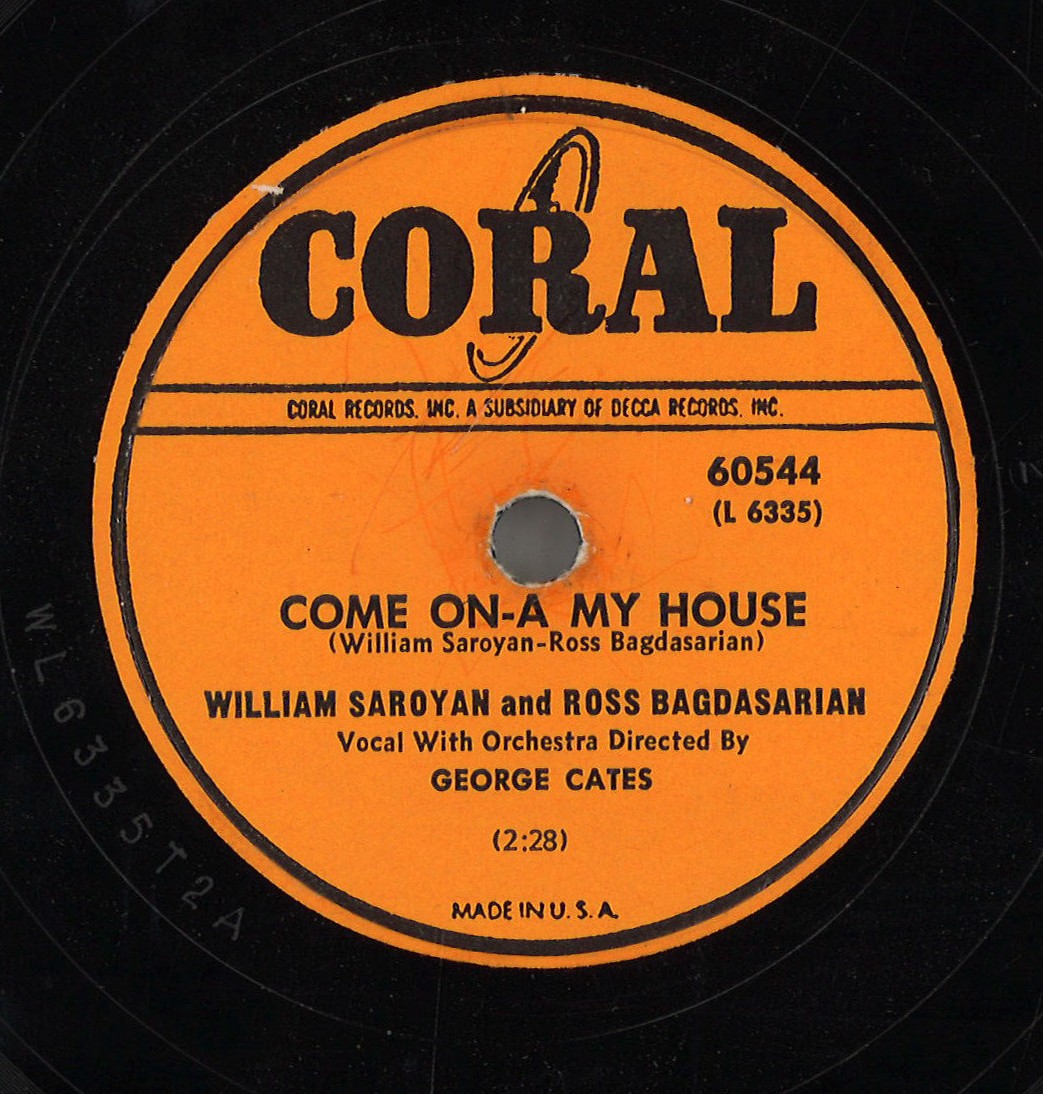
A three-record set of Saroyan in his own inimitable voice. Portions can be listened to at foreversaroyan.com/interviews.
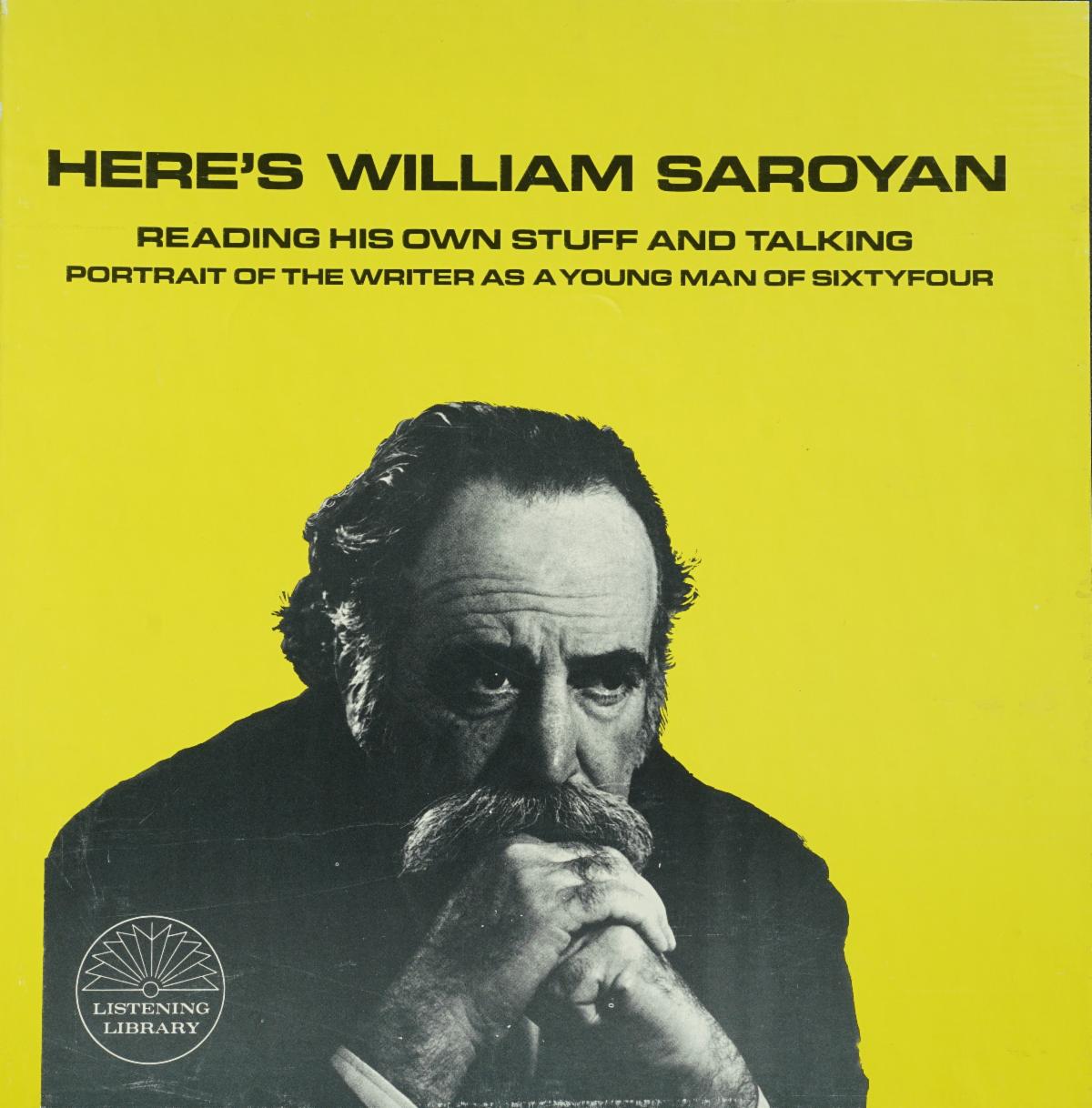
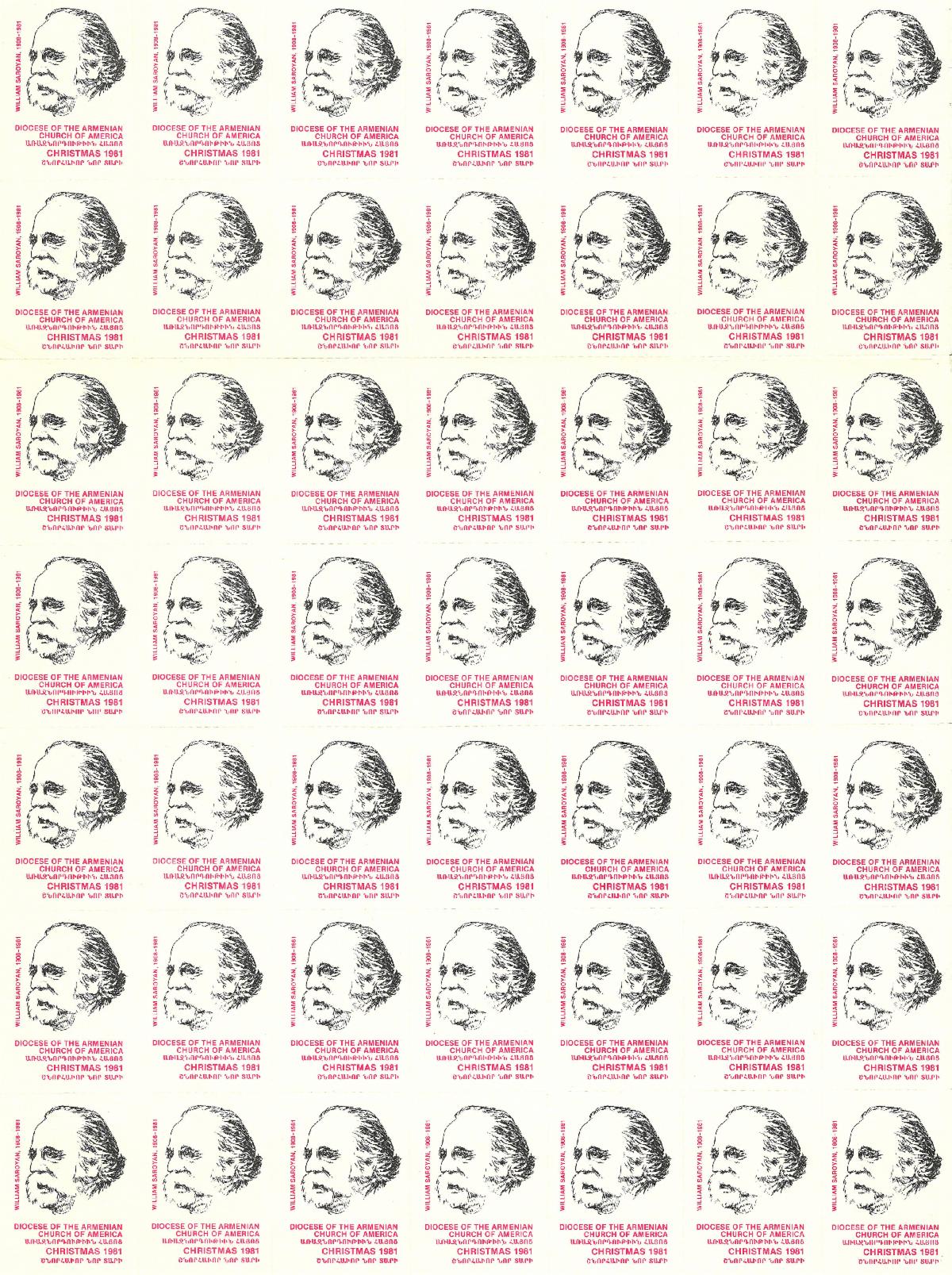
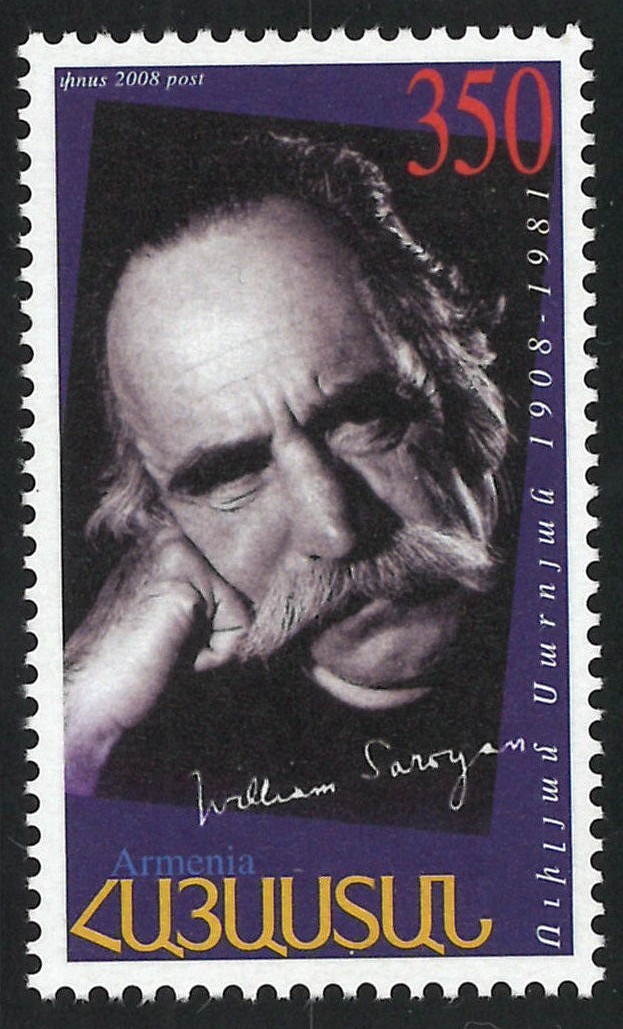
We conclude with what, at this point, may be the iteration of William Saroyan that is familiar to the most people: posters of the writer featuring "the Saroyan quote." The earliest version, to our knowledge, is the black and white version shown here, apparently created by one Peter Nakashian, and thought to date to the early 1980s. (There is credit or copyright information given.) The other is a 1982 poster copyrighted by WizMen Productions and created by Zaven Khanjian and designer Mher Tavitian.
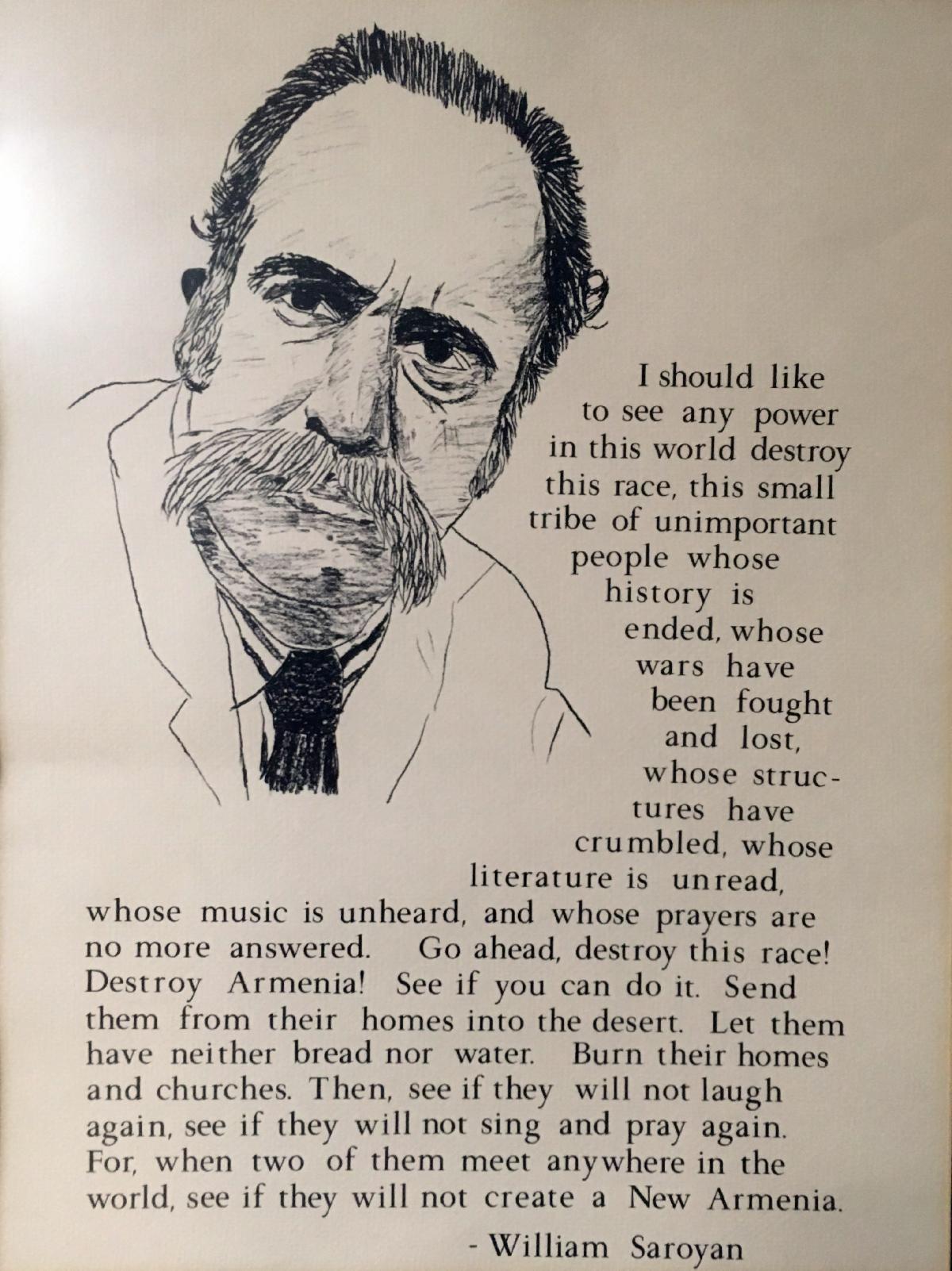
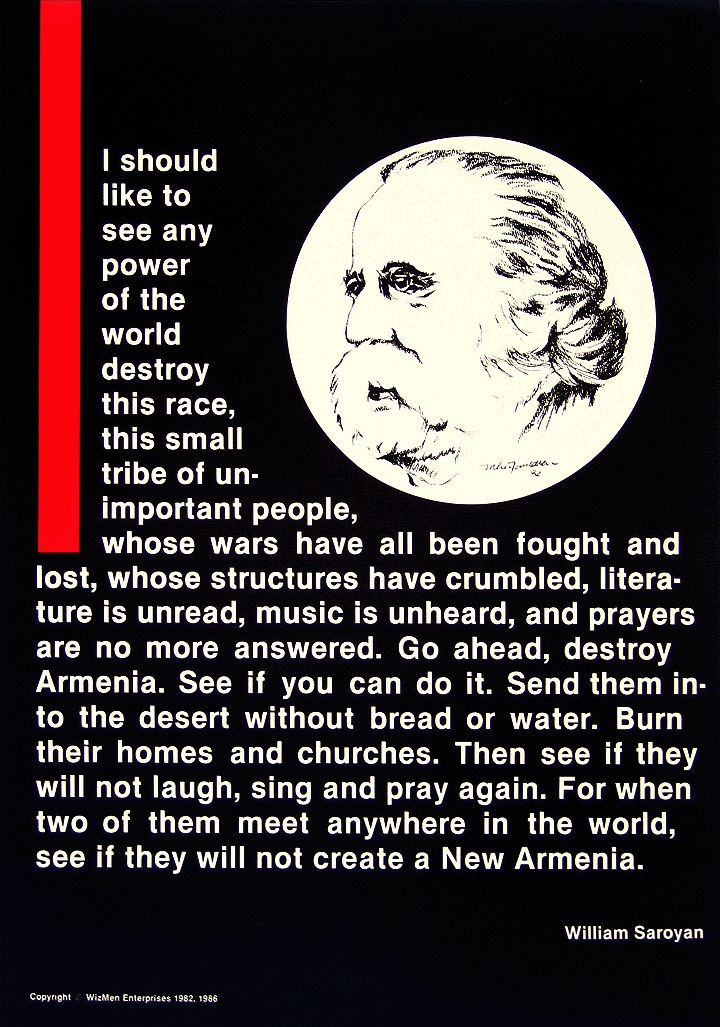
That the words appearing on these and other versions, widely reproduced and quoted and held up as the great writer's ultimate declaration of the admirably stubborn tenacity of the Armenian spirit, almost reflexively invoked whenever two Armenians unexpectedly meet anywhere in the world, are not what he wrote is a topic that has been explored in depth elsewhere; see "The Misquotation of William Saroyan" by Marc Mamigonian. But, to paraphrase the "quotation," we would like to see any power of the world try to convince people that the non-quote isn't what Saroyan wrote! One hopes that Saroyan would appreciate the irony.
Many books by and about William Saroyan are available in the NAASR Bookstore!