This talk explores the role of Reverend Hovhannes Eskijian and his associates in the underground network of humanitarians, missionaries, and diplomats who resisted the destruction of the Armenian people during World War I.
In his talk, Dr. Leupold will argue that these alternative imaginaries of the urban were informed, in an unexpected dialectical twist, both byretrotopian yearningfor a (pre-)colonial past that was coming undone before their eyes andanticipation for a utopian futureat a point of post-revolutionary history largely understood by its contemporaries as the dawn of socialist worldmaking.
The Armenian Genocide Looted Art Research Project (AGLARP) leadership team is planning the project’s second phase and will shed light on recent and upcoming efforts during this conference at UCLA on Saturday, February 10, 2024. This exciting and critical event will consist of a documentary screening about the March conference, discussions of the AGLARP’s summer research findings, and a roundtable on how this conversation applies to past and current events, as well as what lies next for the AGLARP.
In 2021, Büke Uras published his most comprehensive publication to date, “Balyans, Ottoman Architecture and Balyan Archive.” The Mayor of Istanbul financed the 3rd and 4th editions of the book and decided it to be the official diplomatic gift of Istanbul Municipality, a first in Republic’s history for an item of Armenian subject.
The Horrors of Adana offers one of the first close examinations of these events, analyzing sociopolitical and economic transformations that culminated in a cataclysm of violence. Drawing on primary sources in a dozen languages, he develops an interdisciplinary approach to understand the rumors and emotions, public spheres and humanitarian interventions that together informed this complex event.
Professor Ron Suny, emeritus of the University of Chicago and the University of Michigan -- and author of a major study of the massacres and deportations committed by the Ottoman Turks in 1915, "They Can Live in the Desert But Nowhere Else": A History of the Armenian Genocide (Princeton University Press, 2015) -- uses the insights of Moses' work to take a fresh look at the Armenian tragedy and how it provides another lens to look at the concept of genocide.
This audio-visual presentation, featuring rare archival material, photographs and video clips, sheds light on the massive life-saving impact of the Near East Relief and more specifically, the Kerr family, on a generation of survivors of the Armenian Genocide. Responding to horrific eyewitness accounts and urgent pleas for help, the U.S. mobilized an unprecedented campaign of humanitarian assistance led by the Near East Relief (NER) and given legs by a small army of relief workers who risked their lives to help the destitute survivors in distant, dangerous lands. Among the volunteers was Stanley Kerr, a young biochemist in the U.S. Army who, learning of the opportunity to join the relief effort, in 1919 boarded a ship to the crumbling Ottoman Empire.
In 2019, both houses of U.S. Congress recognized the Armenian Genocide, followed by President Biden’s official recognition on April 24, 2021. Their goal achieved, Armenian activists and organizations were now faced with the question: “What’s next?” This conference begins to examine this question.
This international conference celebrates the bicentenary of the founding of Kolkata's famed Armenian College (est. 1821), one of three centers of Armenian higher learning in the diaspora during the nineteenth century and the only one that has survived and is thriving today. Bringing together economic, literary, legal, and cultural historians from India, Armenia, France, the United Kingdom, Germany, and the United States, the conference highlights how, beginning in the early modern period and continuing to the present, Armenians have traveled to India to make its distant shores and cultures their own.



 This talk explores the role of Reverend Hovhannes Eskijian and his associates in the underground network of humanitarians, missionaries, and diplomats who resisted the destruction of the Armenian people during World War I.

 In his talk, Dr. Leupold will argue that these alternative imaginaries of the urban were informed, in an unexpected dialectical twist, both by retrotopian yearning for a (pre-)colonial past that was coming undone before their eyes and anticipation for a utopian future at a point of post-revolutionary history largely understood by its contemporaries as the dawn of socialist worldmaking.

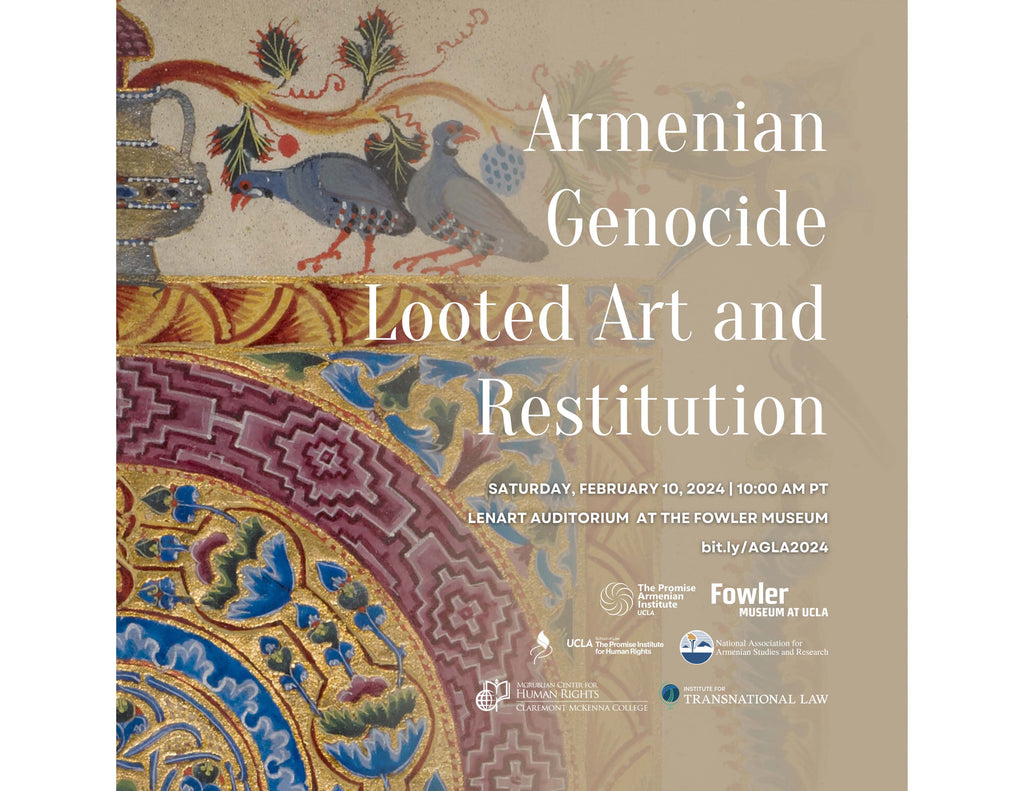 The Armenian Genocide Looted Art Research Project (AGLARP) leadership team is planning the project’s second phase and will shed light on recent and upcoming efforts during this conference at UCLA on Saturday, February 10, 2024. This exciting and critical event will consist of a documentary screening about the March conference, discussions of the AGLARP’s summer research findings, and a roundtable on how this conversation applies to past and current events, as well as what lies next for the AGLARP.

 In 2021, Büke Uras published his most comprehensive publication to date, “Balyans, Ottoman Architecture and Balyan Archive.” The Mayor of Istanbul financed the 3rd and 4th editions of the book and decided it to be the official diplomatic gift of Istanbul Municipality, a first in Republic’s history for an item of Armenian subject.

 The Horrors of Adana offers one of the first close examinations of these events, analyzing sociopolitical and economic transformations that culminated in a cataclysm of violence. Drawing on primary sources in a dozen languages, he develops an interdisciplinary approach to understand the rumors and emotions, public spheres and humanitarian interventions that together informed this complex event.

 Professor Ron Suny, emeritus of the University of Chicago and the University of Michigan -- and author of a major study of the massacres and deportations committed by the Ottoman Turks in 1915, "They Can Live in the Desert But Nowhere Else": A History of the Armenian Genocide (Princeton University Press, 2015) -- uses the insights of Moses' work to take a fresh look at the Armenian tragedy and how it provides another lens to look at the concept of genocide.

 This audio-visual presentation, featuring rare archival material, photographs and video clips, sheds light on the massive life-saving impact of the Near East Relief and more specifically, the Kerr family, on a generation of survivors of the Armenian Genocide. Responding to horrific eyewitness accounts and urgent pleas for help, the U.S. mobilized an unprecedented campaign of humanitarian assistance led by the Near East Relief (NER) and given legs by a small army of relief workers who risked their lives to help the destitute survivors in distant, dangerous lands. Among the volunteers was Stanley Kerr, a young biochemist in the U.S. Army who, learning of the opportunity to join the relief effort, in 1919 boarded a ship to the crumbling Ottoman Empire.

 A conversation between Dr. Abraham Terian and Dr. S. Peter Cowe "For a Better Understanding of St. Gregory of Narek's Prayers"

 In 2019, both houses of U.S. Congress recognized the Armenian Genocide, followed by President Biden’s official recognition on April 24, 2021. Their goal achieved, Armenian activists and organizations were now faced with the question: “What’s next?” This conference begins to examine this question.

 This international conference celebrates the bicentenary of the founding of Kolkata's famed Armenian College (est. 1821), one of three centers of Armenian higher learning in the diaspora during the nineteenth century and the only one that has survived and is thriving today. Bringing together economic, literary, legal, and cultural historians from India, Armenia, France, the United Kingdom, Germany, and the United States, the conference highlights how, beginning in the early modern period and continuing to the present, Armenians have traveled to India to make its distant shores and cultures their own.