

Prior Years — #NAASRevents
BILINGUALISM: Challenges and Benefits of Learning and Living in Multiple Worlds ~ Thursday, March 5, 2020


Thursday, March 5, 7:30-9:30 pmHarvard University Science Center, Auditorium A1 Oxford Street, Cambridge, MA 02138Join us for a discussion on:BILINGUALISM: THE CHALLENGES AND BENEFITS OF LEARNING AND LIVING IN MULTIPLE WORLDSMODERATED by Dr. Anna Ohanyan, Richard B. Finnegan Distinguished Professor of Political Science and International Relations, Stonehill CollegeFEATURINGDr. Lisa Gulesserian, Preceptor on Armenian Studies, Harvard University)Dr. Vartan Matiossian, Executive Director, Armenian Prelacy of the Eastern United StatesDr. María Luisa Parra-Velasco, Senior Preceptor in Romance Languages & Literatures Harvard UniversitySoccer or Saturday School? Parents in diasporic communities routinely grapple with the challenge of carving out time for their children to engage with and experience...
THE RUINS OF ANI: From Sacred Landscape to Political Soil with Peter Balakian and Aram Arkun ~ Thursday, February 27, 2020


Thursday, February 27, 2020 at 7:30 pm NAASR Batmasian Hall, 395 Concord Avenue, Belmont, MA 02478 Join us in NAASR's Batmasian Hall for a presentation by Peter Balakian, editor and Aram Arkun, translator of The Ruins of Ani by Krikor Balakian. From the tenth to the thirteenth centuries, the city of Ani was the jewel of the Armenian kingdom, renowned far and wide for its magnificent buildings. By the fifteenth century, Ani was virtually abandoned, its stunning buildings left to crumble. Yet its ruins have remained a symbol of cultural accomplishment that looms large in the Armenian imagination. Today, Ani...
ROVING REVOLUTIONARIES: A Book Talk with Houri Berberian ~ Thursday, February 27, 2020

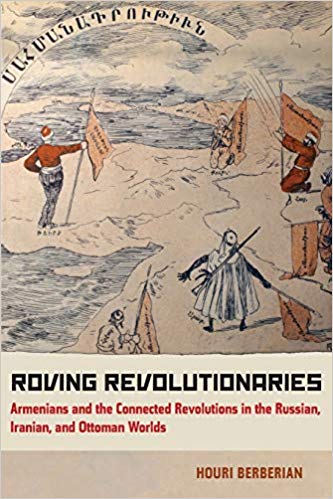
Thursday, February 27, 2020, 6:10-7:30 pm Columbia University Knox Hall, Room 208 606 W 122nd St, New York, NY 10027 Three of the formative revolutions that shook the early twentieth-century world occurred almost simultaneously in regions bordering each other. Though the Russian, Iranian, and Young Turk Revolutions all exploded between 1904 and 1911, they have never been studied through their linkages until now. Roving Revolutionaries probes the interconnected aspects of these three revolutions through the involvement of the Armenian revolutionaries—minorities in all of these empires—whose movements and participation within and across frontiers tell us a great deal about the global...
THE HAMIDIAN MASSACRES AND THE ARMENIAN LAND QUESTION IN THE LATE OTTOMAN EMPIRE with Dr. Mehmet Polatel ~ Sunday, February 23, 2020


Sunday, February 23, 2020, at 4:00 pm Ararat-Eskijian Museum, Sheen Chapel 15105 Mission Hills Road, Mission Hills, CA 91345 In the 1910s, the Armenian land question, which referred to the question of what would happen to the seized properties of Armenians, was one of the most debated topics in the Ottoman Empire. This talk explores the emergence and transformation of this social problem based on the Armenian, British and Ottoman sources. Scrutinizing the changes in the characteristics of actors involved in the seizure of Armenian properties, and the scale and geographical distribution of these seizures in the period between the mid-19th...
WHEN WAS THE DECISION TO ANNIHILATE THE ARMENIANS TAKEN? A Presentation of New Research by TANER AKÇAM ~ Thursday, February 20, 2020


Thursday, February 20, 2020, at 7:30 pm NAASR Vartan Gregorian Building, Batmasian Hall, on the 3rd floor Reception after the program in the Shahinian SolariumIn this presentation of recent research, Taner Akçam argues that documents from the Ottoman archives in Istanbul indicate that first decision to exterminate Armenians was taken on December 1, 1914, well before most scholars have thought. Another document, a letter by Bahaettin Şakir, one of the main architects of the Armenian Genocide, written on March 3, 1915, says that the Central Committee of Union and Progress had decided to exterminate the Armenians, giving the government wide authority...